Pageviews last month

Friday, July 19, 2019

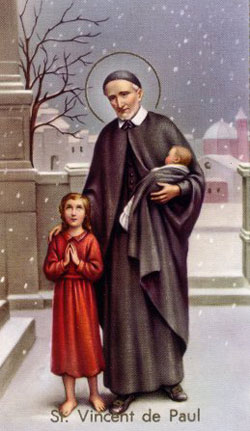
Image of St. Vincent de Paul


ST VINCENT DE PAUL
St. Vincent de Paul was born to a poor peasant family in the French village of Pouy on April 24, 1581. His first formal education was provided by the Franciscans. He did so well, he was hired to tutor the children of a nearby wealthy family. He used the monies he earned teaching to continue his formal studies at the University of Toulose where he studied theology.
He was ordained in 1600 and remained in Toulose for a time. In 1605, while on a ship traveling from Marseilles to Narbone, he was captured, brought to Tunis and sold as a slave. Two years later he and his master managed to escape and both returned to France.
St. Vincent went to Avignon and later to Rome to continue his studies. While there he became a chaplain to the Count of Goigny and was placed in charge of distributing money to the deserving poor. He became pastor of a small parish in Clichy for a short period of time, while also serving as a tutor and spiritual director.
From that point forward he spent his life preaching missions to and providing relief to the poor. He even established hospitals for them. This work became his passion. He later extended his concern and ministry to convicts. The need to evangelize and assist these souls was so great and the demands beyond his own ability to meet that he founded the Ladies of Charity, a lay institute of woman, to help, as well as a religious institute of priests - the Congregation of Priests of the Mission, commonly referred to now as the Vincentians.
This was at a time when there were not many priests in France and what priests there were, were neither well-formed nor faithful to their way of life. Vincent helped reform the clergy and the manner in which they were instructed and prepared for the priesthood. He did this first through the presentation of retreats and later by helping develop a precursor to our modern day seminaries. At one point his community was directing 53 upper level seminaries. His retreats, open to priests and laymen, were so well attended that it is said he infused a "Christian spirit among more than 20,000 persons in his last 23 years."
He was eighty years old when he died in Paris on September 27, 1660.He had "become the symbol of the successful reform of the French Church". St. Vincent is sometimes referred to as "The Apostle of Charity" and "The Father of the Poor".
His incorrupt heart can be found in the Convent of the Sisters of Charity and his bones have been embedded in a wax effigy of the Saint located at the Church of the Lazarist Mission. Both sites are located in Paris, France.
Two miracles have been attributed to St Vincent - a nun cured of ulcers and a laywoman cured of paralysis. As a result of the first, Pope Benedict XIII beatified him on August 13, 1729. Less than 8 years later (on June 16, 1737) he was canonized by Pope Clement XIII. The Bull of Canonization recognized Vincent for his charity and reform of the clergy, as well as for his early role in opposing Jansenism.
It has been reported that St. Vincent wrote more than 30,000 letters in his lifetime and that nearly 7,000 had been collected in the 18th century. There are at least five collections of his letters in existence today.

Saturday, July 13, 2019

We got a new computer and it has taken me all this time to find the blogger site!!   Today's saint is SORELY needed in this world today!!

ST FRANCIS SOLANO
Related image


This Saint, who was rightfully named "the Apostle of America", is one of the greatest missionaries that the Franciscan Order has produced.  He was born at Montilla Spain, where he grew up under the eyes of his pious parents, and was educated by the Jesuits. 

At the age of twenty, he put on the Franciscan habit at the friary in his native town.  He was ordained a priest, and took up preaching, at the same time practicing all the religious virtues with seraphic fervour.  He preached first in Spain, then in America, where he found a large field for apostolic work awaiting him.  In 1589, he set sail for the New World.  The ship which was carrying him sank during the crossing.  Francis jumped into the sea, holding his crucifix in his hands, and swam ashore.  Later, a vessel took him to Lima, where there was a monastery of his Order.  Several days later, he set out for the Tucuman, about 1800 miles from Lima.  His amazing apostolate influenced areas as far distant as the vast reaches of Paraguay.

God performed numerous striking miracles on his behalf, in fact, they filled his life in uninterrupted sequence:  he cured the sick, restored the dead to life, and sometimes crossed rivers on his cloak.  Each of the numerous peoples of Tucuman and Paraguay had their own language;  Francis learnt them all so well that he could speak them like the natives.  He brought back thousands of sinners, and converted an incalculable number of pagans to the Christian faith.  He died on July 14, 1610.

Saturday, May 25, 2019

This is the 13th Station -Jesus is taken down from the cross.  I just cannot get over the amount of emotion that the artist put into the face of the Blessed Mother.  This is just a piece of plaster and you would have to be blind not to see the extreme pain and emotionally draining sorrow that is present in her heart and on her face!  I truly think that people today cannot reproduce these emotions because there is no one that is  willing to use the grace that the Good God gives to those with talent in this field.  These stations of the cross are in our church in Waubeka, Wisconsin.

Friday, May 24, 2019

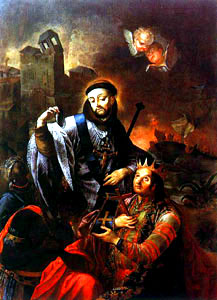
 I read somewhere that California is trying to outlaw the "seal of the confessional" with a law that would make it a crime for a priest or other clergy man to conceal a crime that was revealed in the confessional.  Here is the saint  (martyr) that lost his life refusing to cave into such pressure:

St John Nepomucene, Martyr of the Seal of the Confessional


From Catholic Online

In his early childhood, John Nepomucene was cured of a disease through the prayers of his good parents. In thanksgiving, they consecrated him to the service of God. After he was ordained, he was sent to a parish in the city of Prague. He became a great preacher, and thousands of those who listened to him changed their way of life. Father John was invited to the court of Wenceslaus IV. He settled arguments and did many kind deeds for the needy people of the city. He also became the queen's confessor. When the king was cruel to the queen, Father John taught her to bear her cross patiently. One day, about 1393, the king asked him to tell what the queen had said in confession. When Father John refused, he was thrown into prison. A second time, he was asked to reveal the queen's confession. "If you do not tell me," said the king, "you shall die. But if you obey my commands, riches and honor will be yours." Again Father John refused. He was tortured. The king ordered to be thrown into the river. Where he drowned, a strange brightness appeared upon the water. He is known as the "martyr of the confessional." He is patron of Czechoslovakia, where he is invoked against floods and against slander. His feast day is May 16.

Tuesday, May 14, 2019

Tuesday, April 23, 2019

Thursday, April 18, 2019

Image may contain: 3 people, indoor 
 The Last Supper (19th century), Carl Bloch

And whilst they were at supper, Jesus took bread, and blessed, and broke: and gave to his disciples, and said: Take ye, and eat. This is my body. [27] And taking the chalice, he gave thanks, and gave to them, saying: Drink ye all of this. [28] For this is my blood of the new testament, which shall be shed for many unto remission of sins