No one, however weak, is denied a share in the victory of the cross.
No one is beyond the help of the prayer of Christ. His prayer brought
benefit to the multitude that raged against him. How much more does it
bring to those who turn to him in repentance. – St. Leo the Great
Thursday, June 28, 2018

Tuesday, June 19, 2018

Mount Calvary is the mount of lovers. All love that does not take its origin from the Savior’s passion is foolish and perilous. Unhappy is love without the Savior’s death. Love and death are so mingled in the Savior’s passion that we cannot have one in our hearts without the other. Upon Calvary, we cannot have life without love, or love without the Redeemer’s death.
St. Francis de Sales
Friday, June 8, 2018

As they were looking on, so we too gaze on his wounds as he hangs. We see his blood as he dies. We see the price offered by the redeemer, touch the scars of his resurrection. He bows his head, as if to kiss you. His heart is made bare open, as it were, in love to you. His arms are extended that he may embrace you. His whole body is displayed for your redemption. Ponder how great these things are. Let all this be rightly weighed in your mind: as he was once fixed to the cross in every part of his body for you, so he may now be fixed in every part of your soul. –
St. Augustine
Monday, June 4, 2018

Thursday, May 31, 2018

Jesus, My Lord, My God, My All
Fredrick W. Faber 1814-1863
Tune: Sweet Sacrament
Jesus, my Lord, my God, my All,
How can I love Thee as I ought?
And how revere this wondrous gift,
So far surpassing hope or thought?
How can I love Thee as I ought?
And how revere this wondrous gift,
So far surpassing hope or thought?
Sweet Sacrament, we Thee adore!
O make us love Thee more and more!
O make us love Thee more and more.
O make us love Thee more and more!
O make us love Thee more and more.
Had I but Mary's sinless heart,
To love Thee with, my dearest King
O! with what bursts of fervent praise,
Thy goodness, Jesus would I sing!
To love Thee with, my dearest King
O! with what bursts of fervent praise,
Thy goodness, Jesus would I sing!
Sweet Sacrament, we Thee adore!
O make us love Thee more and more!
O make us love Thee more and more!
O make us love Thee more and more!
O make us love Thee more and more!
O make us love Thee more and more!
O make us love Thee more and more!
St. Justin Martyr
Wednesday, May 30, 2018
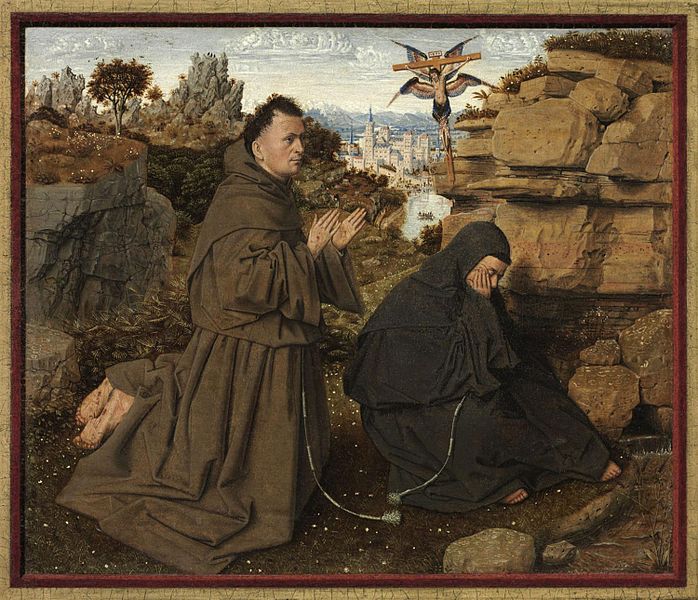
One of life’s great scandals is pain. Not only in ourselves but in
others. Pain will always be a trouble to the human mind as well as to
the human body. How did our Lord look upon it? When he went into the
Garden of Gethsemane on Holy Thursday night, there was an alternative
presented to him: the alternative of the sword and the cup.
As he abandons himself to his Father’s will, coming down on this moonlit
night is a band of about 200 led by Judas. Peter takes out a sword to
defend our blessed Lord…. Our Lord said to Peter, ‘Put the sword back
again into its scabbard. Shall I not drink the cup my Father gave?’ asks
Jesus. ‘My Father’? Not Pilate? Not Herod? Not you and me? Not the
people? Is this the cup the loving Father gives? That’s precisely the
point.
All pains, all trials of life pass through God’s hands
first, before they ever come to us. Before Satan could strike Job, God
reviewed the punishments that Satan would visit upon Job and said ‘You
may touch everything except his soul.’ And so what our blessed Lord is
saying is that the pains that we have are seen and known by the Father.
That was the way he looked on pain.
—ARCHBISHOP FULTON SHEEN
from A Voice from Calvary
Thursday, May 24, 2018
A CHURCH which is not one in its
doctrine and faith can never be the True Church. Hence, because truth
must be one, of all the different churches, only one can be the true
one, and
outside of that Church there is no salvation.
Now, in order to determine which is this
one true Church, it is necessary to examine which is the Church first
founded by Jesus Christ, for when this is ascertained, it must be
confessed that
this one alone is the true Church which, having once been the true
Church must always have been the true Church and must forever be the
true Church. For to this first Church has been made the promise of the
Savior that the gates of Hell would never be able
to overturn it [Matt 16:18].
In the entire history of religion, we find that the
Roman Catholic Church alone was the first Church, and that the
other false and heretical churches afterwards departed and separated
from her. This is the Church which was propagated by the Apostles and
afterwards governed by pastors whom the Apostles
themselves appointed to rule over her. This character can be found only
in the Roman Church, whose pastors descend securely by an uninterrupted
and legitimate succession from the Apostles of the world [Matt
28:20].
The innovators themselves do not deny
that the Roman Church was the first which Jesus Christ founded. However,
they say that it was the true Church until the fifth century, or until
it fell
away, because it had been corrupted by the Catholics. But how could
that Church fall which St. Paul calls the "pillar and ground of truth" [1 Timothy 3:15]? No, the Church has
not failed. The truth is, that all the false churches, which have separated from the Roman Church, have fallen away and erred.
To convince all heretical sects of their
error, there is no way more certain and safe than to show that our
Catholic Church has been the first one founded by Jesus Christ. For,
this being
established, it is proved beyond all doubt that ours is the only true Church
and that all the others which have left it and separated are certainly
in error. But, pressed by this argument, the innovators have invented an
answer. They say that the visible
Church has failed, but not the invisible Church. But these doctrines
are diametrically opposed to the Gospel.
The innovators have been challenged
several times to produce a text of Sacred Scripture which would prove
the existence of the invisible church they invented, and we are unable
to obtain any
such text from them. How could they adduce such a text when, addressing
His Apostles whom He left as the propagators of His Church, Jesus said:
"You cannot be hidden" [Matt 5:14].
Thus He has declared that the Church
cannot help but be visible to everyone. The Church has been at all
times, and will forever be, necessarily visible, so that each person may
always be able
to learn from his pastor the true doctrine regarding the dogmas of
faith, to receive the Sacraments, to be directed in the way of
salvation, and to be enlightened and corrected should he ever fall into
error.
For, were the Church in any time hidden
and invisible, to whom would men have recourse in order to learn what
they are to believe and to do? It was necessary that the Church and her
pastors
be obvious and visible, principally in order that there might be
an infallible judge, to resolve all doubts, and to whose decision
everyone should necessarily submit. Otherwise, there would be no sure
rule of faith by which Christians could know the
true dogmas of faith and the true precepts of morality, and among the
faithful there would be endless disputes and controversies. "And Christ
gave some apostles, and others pastors and doctors, that henceforth we
be no more children tossed to-and-fro and carried
about with every wind of doctrine" [Eph 4:11-14].
But what faith can we learn from these
false teachers when, in consequence of separating from the Church, they
have no rule of faith. How often Calvin changed his opinions! And,
during his
life, Luther was constantly contradicting himself: on the single
article of the Eucharist, he fell into thirty-three contradictions! A
single contradiction is enough to show that they did not have the Spirit of God.
"He cannot deny Himself" [2 Timothy 2:13].
In a word, take away the authority of the Church, and neither Divine
Revelation nor natural reason itself is of any use, for each of them
may be interpreted by every individual according to his own caprice. Do
they not see that from this accursed liberty of conscience has arisen
the immense variety of heretical and atheistic
sects? I repeat: if you take away obedience to the Church, there is no error which will not be embraced.
St. Alphonsus de Ligouri
Subscribe to:
Posts (Atom)