Pageviews last month

Wednesday, April 29, 2015

The Rosary of the Seven Sorrows 
The Rosary of the Seven Sorrows consists of 7 groups of 7 beads, with 3 additional beads and a Crucifix. Say each of the sorrow below followed by 7 Hail Mary's. The 7 groups of 7 Hail Mary's are recited in remembrance of the 7 Sorrows of Mary:


1. The prophecy of Simeon.

2. The flight into Egypt.

3. The loss of the Child Jesus in the Temple

.4. Mary meets Jesus carrying His cross.

5. The Crucifixion

6. Mary received the Body of Jesus from the cross

7. The Body of Jesus is placed in a tomb.


3 Hail Mary's are added in remembrance of the tears Mary shed because of the suffering of her Divine Son. These are said to obtain true sorrow for our sins.

The concluding prayer follows:


V/. Pray for us, O most sorrowful Virgin.

R/. That we may be made worthy of the promises of Christ.


Let us pray:

Lord Jesus, we now implore, both for the present and for the hour of our death, the intercession of the most Blessed Virgin Mary, Thy Mother, whose holy soul was pierced at the time of Thy passion by a sword of grief. Grant us this favor, O Saviour of the world, Who livest and reignest with the Father and the Holy Ghost , forever and ever. Amen.

Monday, April 27, 2015

O Christ Jesus, when all is darkness and we feel our weakness and helplessness, give us the sense of Your presence, Your love, and Your strength. Help us to have perfect trust in Your protecting love and strengthening power, so that nothing may frighten or worry us, for, living close to You, we shall see Your hand, Your purpose, Your will through all things.


- St. Ignatius of Loyola

Sunday, April 26, 2015


When we say that Mary is the Mother of God, we speak of a dignity that is above every other dignity that can be named, or thought of, after that of God. Nothing equals Mary, for all is either above her, and this is God, or beneath her, and this is all that is not God.
St. Anselm of Canterbury (1033-1109AD)

Friday, April 17, 2015

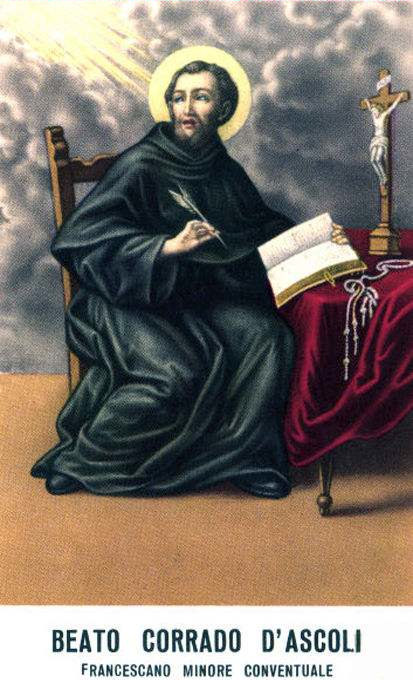
April 19 – Blessed Conrad of Ascoli


Friar Minor and missionary, born at Ascoli in the March of Ancona in 1234; died there, 19 April, 1289.
He belonged to the noble family of Milliano and from his earliest years made penance the predominating element of his life.
Bl. Conrad of Ascoli

He entered the Order of Friars Minor at Ascoli together with his townsman and lifelong friend, Girolamo d’Ascoli, afterwards minister general, and later pope under the title of Nicholas IV. Having completed his studies at Perugia, Conrad was sent to Rome to teach theology. Later he obtained permission to go to Africa, where he preached with much fruit through the different provinces of Libya and worked numerous miracles. He was recalled from Africa to go on a mission to the King of France, then at war with Spain, and subsequently he became lector of theology at Paris.
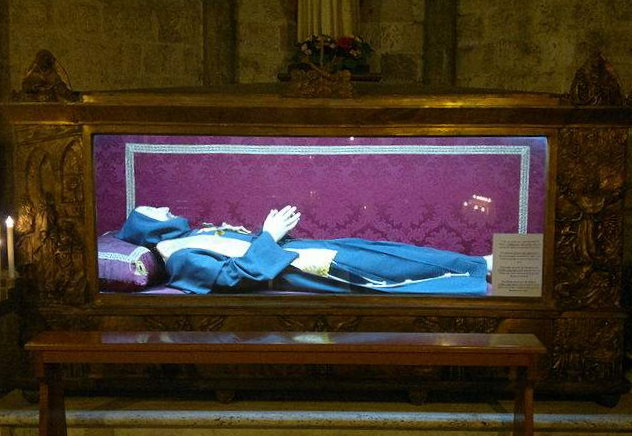
The Incorrupt body of Blessed Conrad of Ascoli in the Church of San Francesco in Ascoli Piceno, Italy. Photo by Revares.The Incorrupt body of Blessed Conrad of Ascoli in the Church of San Francesco in Ascoli Piceno, Italy. Photo by Revares

When not engaged in teaching, Conrad preached to the people or ministered to the sick in hospitals. In 1288 he was summoned to Rome by the new pope, Nicholas IV, who wished to make him cardinal, but Conrad died on the way after reaching his native city, being then fifty-five years of age.

Nicholas IV was deeply grieved at the loss of his saintly friend, on whose counsel and zeal he had counted so much, and declared that Conrad’s death was a great loss to the Church. The people of Ascoli erected a splendid tomb over the remains of Blessed Conrad. In 1371, when his body was removed to the new church of the Franciscans, it was found incorrupt and gave forth a sweet odour. Pius VI approved the cultus of Blessed Conrad. His feast is kept in the Order of Friars Minor on 19 April.
STEPHEN M. DONOVAN

Wednesday, April 15, 2015


Picture from St. Thomas Aquinas Book Club


“Never will anyone who prays his Rosary every day be led astray.” St. Louis de Montfort

Saturday, April 11, 2015

THE MIRACLE OF THE EUCHARIST - Santarem, Portugal


Around the year 1225 there was a woman living in Santarem, who was very
unhappy with her marriage. She was convinced that her husband did not love
her, and was unfaithful. After many prayers and no relief from her
problems, she turned to a sorceress for help.

The sorceress promised the wife that her husband would return to his loving
ways, if the wife would bring her a Consecrated Host.

The woman was aware of the grave offense to God, and was frightened with
the prospect of committing a horrible sacrilege but unfortunately gave in
to temptation. She went to Mass at the Church of St. Stephen, and received
Communion, but did not consume the Host. Instead, she left the Church
immediately, and took the Host out of her mouth, putting It into her veil.

As she headed for the sorceress' cave, the first miracle occurred. Within
moments, blood began to issue from the host. The amount of blood was such
that it soon dripped from the cloth and attracted the attention of
bystanders who asked if she needed assistance. Becoming even more
frightened by the unexpected turn of events, she hurried home instead of
the sorcerer's cave, and put the veil with the host in a wooden chest in
the bedroom.

The second miracle took place that very night when both she and her husband
were awakened by a mysterious light penetrating through the wooden chest.
The woman then confessed her sin to her husband and they both spent the
remainder of the night on their knees in adoration. The following morning,
the parish priest was informed and people rushed to the house to
contemplate the Holy Miracle. The priest brought the host back to the
church in solemn procession, placed it in a small case of wax; and
deposited it in the tabernacle. A Church investigation was promptly
organized.

A third miracle occurred later when the priest opened the tabernacle door
and found the wax container had broken into small pieces. In its place was
a beautiful crystal pyx with the blood of the host inside. The pyx is
approximately 1/2" thick and 2" in diameter, crystalline clear and with a
small protrusion on the side that contains the largest collection of blood.
It is irregularly shaped crystal through which can be seen the real flesh
with delicate veins running from top to bottom and a quantity of blood
which is collected at one end.

It was later placed in a gold and silver pear-shaped monstrance with a
sunburst of 33 rays where it remains today. The reliquary that houses the
miraculous Host rests above the tabernacle, and can be viewed atop a set of
stairs from behind the main altar.

After the investigation and approval by the Church authorities, the Church
of St. Stephen was renamed "The Church of the Holy Miracle." The little
house where the miracle occurred was on Via delle Stuoie in Santarem.

From the time of the miracle until now, every year, on the Second Sunday of
April, the incident is re-enacted by local actors. The actual Eucharistic
Miracle is processed from the house, which was converted into a Chapel in
1684, to the Church. Miraculously, after 750 years, the precious blood
still remains in liquid form, defying the natural laws of science. The Host
is somewhat irregularly shaped, resembling real flesh with delicate veins
running from top to bottom, where a quantity of blood is collected in the
crystal.

This case, along with many other Eucharistic miracles, gives witness to the
real presence of Our Lord Jesus Christ in the Holy Eucharist.

Wednesday, April 8, 2015

[Madonna-Rosario2_.jpg]
It is the nature of Jesus Christ to lead us surely to the Father. In the same way, it is the nature of the Blessed Virgin to lead us surely to Jesus.
St. Louis Grignion de Montfort (1673-1716AD)