Pageviews last month

Monday, March 31, 2014

April 2 – St. Francis of Paola and the Bartlett Pear

The Bartlett pear is called “The Good Christian” in France, after St. Francis of Paola introduced it

Pears 
‘poire bon chretien’ (good Christian pear)
 
“Said to have originated in Calabria in southern Italy, Bartletts probably were introduced to France by St. Francis of Paola. St. Francis brought a young tree as a gift for King Louis XI of France, who had summoned him in the hope that the saint would miraculously cure the king’s many illnesses. When the king died in 1483, St. Francis returned to Italy, but he left behind the legacy of his pear tree, called by the French the ‘poire bon chretien’ (good Christian pear).”
Nick Malgieri is the author of “Perfect Cakes” and “A Baker’s Tour” (HarperCollins) and “Perfect Light Desserts” (Morrow).
http://www.washingtontimes.com/news/2007/sep/19/heavenly-32bartletts/

Saturday, March 29, 2014


Audio sermon for today. The non-discriminatory policy as it applies to creed has given us the foundation for a true lack of charity with the illusion of respect and love of our fellow men. The demons are rejoicing in this. If we are truly striving to please God and live virtuously then we must expect attacks from these demons. Temptations are not a sign that we are failing but rather a sign of our progress. The greater the temptations the closer we must be approaching the goal of the love of God. Do not be disheartened by your temptations and failings, but get up and strive even more. Take courage God's grace is sufficient for us. 

 Audio Sermon for today, the Fourth Sunday in Lent. We are children of the Promise. Let us rejoice. Be not envious of the apparent successes of the children of the slave girl (the children of the world). If we realize our inheritance we will no longer fear or dread the sacrifices necessary to obtain Heaven. We can even rejoice in our sacrifices. 


Bishop Giles, OFM
Ladder of Divine Ascent Icon


 The remembrance of death makes us lose all affection for the things of this life.”

St. Alphonsus 

THE ROMAN CATHOLIC CHURCH

Her Doctrine and Morals

Fourth Sunday in Lent

30 March 2014

[Image]

The Sunday

Sermon


Dear Friend,
There is great symbolism in today's Gospel for us to contemplate today. We learn from the parallel Gospel of St. Matthew that the multiplication of bread and fishes was done by Jesus, but He distributed them only through His Disciples. All those who ate were fed by God, but through the hands of the Apostles. 

So, it is that God has seen fit to give us spiritual food throughout history, even to today. If we are to be truly fed the life giving bread of the Word of God, we must approach The Church, or in other words the bishops who have been appointed by the Holy Ghost to sanctify, teach and govern Her. Outside of The Church or outside of Her bishops there is no salvation, because The Word of God is not there. 

Those who have taken the Bible as the word of God and claim to receive it directly from God, deceive themselves. They indeed take food, but in not taking it from the hand of God's ministers their digestion suffers greatly. The Church is the only living authority that is the sole dispenser of the Word of God, and She is also the sole guarantee and protector of It. Those who take the written Word of God and separate it from the Living Tradition and Authority, have some of the raw ingredients for the food for their soul, but they cannot assemble it correctly so that it will give them spiritual life. They have the ingredients, but do not have the recipe, or they refuse to follow the recipe and end up with indigestible truths. Because certain truths are indigestible to them, they then begin to deny and cast out all that they cannot accept. This is what has happened with the Protestants throughout history. Private interpretation demands rejection of whatever is unpalatable to the individual. It is unpalatable because they have refused to receive it correctly from the hands that God has appointed to distribute it. 

The number of believers has been reduced to a remnant, due to this Protestant/Pagan influence in the world. Nonetheless, the Church will continue until the end of time. This God has promised to us. One of the necessary marks of the Church is that She is Apostolic. We, therefore, conclude that there will always be at least one true bishop in the world, and that those who will be saved will receive the life giving spiritual food of the Word of God from the hands of these bishops. 

Noting the Great Apostasy and the fewness of bishops, should not discourage us. Just as Jesus multiplied the bread and fishes, so He can and does multiply the words of His bishops. We have a treasure trove of the recorded teachings of the Apostles and their successors throughout history. The fewness of true bishops today is a result of the diminishing number of true Catholics. Or perhaps the converse is truer: there are few Catholics because there are few true bishops. 

In any case, God has seen fit to offer us a remedy for the scarceness of bishops. The words and teachings of our bishops are multiplied and can be heard throughout the world due to the advances of technology. All those who have access to the World Wide Web, are able to hear their bishops directly, or the priests who have been approved and appointed to teach in their names. 

The governing of the Church can likewise be taken care of from a distance. This leaves us with the matter of sanctification. Many in the world are at such a distance that they cannot receive the sacraments. This has always been a grave concern for the bishops in this time of apostasy. God has seen fit in suggesting to us that we spiritually receive the sacraments when we are physically impeded from doing so. 

It has long been the suggestion and practice in the Church to make frequent Spiritual Communions. We can in spirit repent of our sins and unite our hearts with Jesus in the Most Holy Eucharist. God, Who sees and knows everything, accepts the desire for the deed. Grace is ours for the asking. This is not an empty suggestion given to quiet the consciences of pietistic souls, but is rather a sound practice of the saints throughout history. 

The spiritual reception of the sacraments offers us the opportunity to gain grace at all times and in all places. There is nothing to hinder us. This great desire to receive the physical sacrament very often softens God's Heart to such a point that He will bring a true priest to us, or us to a true priest to receive that which our hearts desire. 

Today, we still see the multiplication of the bread and fishes. We can find the spiritual food we need so that we do not have to faint along the way of this life. Let us beg of God these graces and open up our hearts and minds to receive from God's appointed ministers this life-giving food for our souls.

Wednesday, March 26, 2014

 A deer guarded this noble saint from the unwanted advances of men

St. Catherine of Sweden

Patroness against abortion and miscarriage.

St. Catherine of Sweden. Photo by Smas.
The fourth child of Saint Bridget and her husband, Ulf Gudmarsson, born 1331 or 1332; died 24 March, 1381. At the time of her death Saint Catherine was head of the convent of Wadstena, founded by her mother; hence the name, Catherine Vastanensis, by which she is occasionally called. At the age of seven she was sent to the abbess of the convent of Riseberg to be educated and soon showed, like her mother, a desire for a life of self-mortification and devotion to spiritual things. At the command of her father, when about thirteen or fourteen years, she married a noble of German descent, Eggart von Kürnen. She at once persuaded her husband, who was a very religious man, to join her in a vow of chastity. Both lived in a state of virginity and devoted themselves to the exercise of Christian perfection and active charity. In spite of her deep love for her husband, Catherine accompanied her mother to Rome, where Saint Bridget went in 1349. Soon after her arrival in that city Catherine received news of the death of her husband in Sweden. She now lived constantly with her mother, took an active part in Saint Bridget’s fruitful labours, and zealously imitated her mother’s ascetic life. Although the distinguished and beautiful young widow was surrounded by suitors, she steadily refused all offers of marriage. In 1372 Saint Catherine and her brother, Birger, accompanied their mother on a pilgrimage to the Holy Land; after their return to Rome Saint Catherine was with her mother in the latter’s last illness and death.
In 1374, in obedience to Saint Bridget’s wish, Catherine brought back her mother’s body to Sweden for burial at Wadstena, of which foundation she now became the head. It was the motherhouse of the Brigittine Order, also called the Order of Saint Saviour. Catherine managed the convent with great skill and made the life there one in harmony with the principles laid down by its founder. The following year she went again to Rome in order to promote the canonization of Saint Bridget, and to obtain a new papal confirmation of the order. She secured another confirmation both from Gregory XI (1377) and from Urban VI (1379) but was unable to gain time in the canonization of her mother, as the confusion caused by the Schism delayed the process. When this sorrowful division appeared she showed herself, like Saint Catherine of Siena, a steadfast adherent of the part of the Roman Pope, Urban VI, in whose favor she testified before a judicial commission. Catherine stayed five years in Italy and then returned home, bearing a special letter of commendation from the pope. Not long after her arrival in Sweden she was taken ill and died. In 1484 Innocent VIII gave permission for her veneration as a saint and her feast was assigned to 22 March in the Roman Martyrology. Catherine wrote a devotional work entitled “Consolation of the Soul” (Sielinna Troëst), largely composed of citations from the Scriptures and from early religious books; no copy is known to exist. Generally she is represented with a hind at her side, which is said to have come to her aid when unchaste youths sought to ensnare her.
J. P. Kirsch (Catholic Encyclopedia)

St. Thomas More rejects his wife’s pleas to abandon the Faith


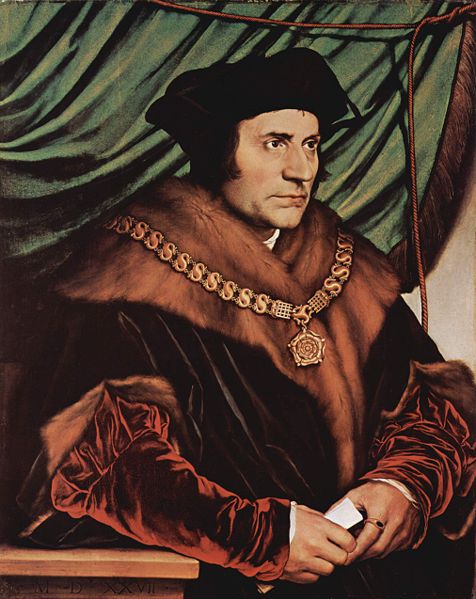
St. Thomas More
St. Thomas More
Thomas More was Lord High Chancellor of England in the reign of King Henry VIII. He was a fervent Catholic, and although zealous in the service of his King, was still more so in the service of God.
When Henry rebelled against the Church, he put into prison, and sometimes even condemned to death, those who would not acknowledge him to be head of the Church in England.
When he informed Sir Thomas More of this law which he had made, requiring his subjects to submit to his authority in spiritual things, Sir Thomas at once replied that he for one would never obey it, “because,” he said, “it is against the law of God.”
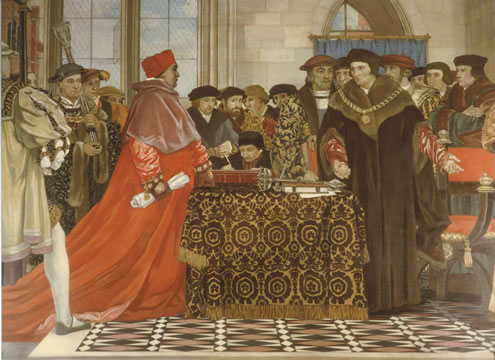
St. Thomas More Defending the Liberty of the House of Commons, painting by Vivian Forbes, 1927, St. Stephen's Hall, English Parliament, London.
St. Thomas More Defending the Liberty of the House of Commons, painting by Vivian Forbes, 1927, St. Stephen’s Hall, English Parliament, London.

The King was very much grieved at Thomas’s refusal, not only because he himself had a great esteem for him, but also because he knew the great influence his example would have over others. So he tried, first by promises, and then by threats, to make him submit.
But it was all in vain, for the faithful servant of the King of Heaven firmly declared that he would sooner die than neglect his duty to God.
This answer put the King into a great passion, and he ordered him to be immediately put into prison. “You shall see,” he said, “that I am your master, and that you must do what I wish.”
“You have, indeed, power over my life, and over everything I have that passes away with life,” replied the intrepid Thomas, “but more than that you have no power over.”
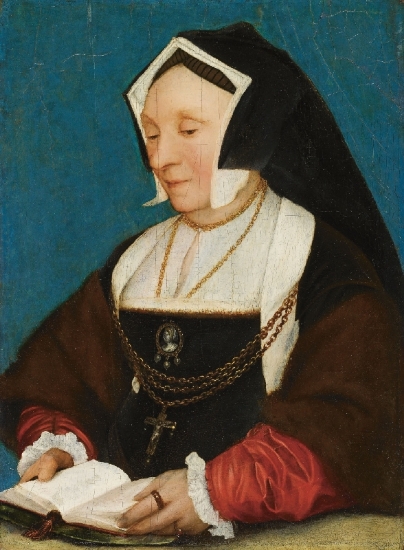
Lady Alice Middleton More
The King condemned him to death. But wishing to give him yet an opportunity of saving his life, he went to Lady Alice, his wife, and persuaded her to go to her husband and to try and influence him by those endearing motives which have most effect upon the human heart.
“O my husband,” she said to him, “do obey the command of the King as others have done, and your life will be spared.”
“And how long, my dear wife,” he answered, “how long do you think I shall live if I do what you ask me?”
“For at least twenty years,” she said.
Sir Thomas More family's vault in St Dunstan's Church. Photo by Liondartois
Sir Thomas More family’s vault in St Dunstan’s Church. Photo by Liondartois

“Well, if you had said twenty thousand years, that would have been something; but it would, indeed, be a very poor thing to live even that number of years, and run the risk of losing my God in eternity! Oh no, dear wife, I thought you would have spoken more wisely to me than that. I will never consent to disobey my God in that way; I promised Him over and over again that I would serve Him faithfully all my days, and love Him with my whole heart, and by His grace I will do it.”
Sir Thomas More died on the scaffold on the sixth day of July, 1535.

Rev. D. Chisholm, The Catechism in Examples (London: R & T Washbourne, Ltd., 1919), 406-7.

Friday, March 21, 2014

St. Louis the King teaches his nobles to hate mortal sinMarch 20, 2014

St. Louis IX
St. Louis, King of France, asked one of his nobles named Joinville what he would do if he were asked to choose between committing a mortal sin and being struck with leprosy.
Joinville, without any hesitation, answered the King: “I would sooner commit ten mortal sins than be infected even once with that terrible plague.” 
The King looked sadly on his friend and said: “Ah! my dear sir, it is evident you do not know what an evil it is to commit a mortal sin. There is no evil so terrible as sin is: for no matter how much we detest our sins, we can never be sure so long as we live whether or not God has forgiven us, or that we have sufficiently repented of them.”

Rev. D. Chisholm, The Catechism in Examples (London: R & T Washbourne, Ltd., 1919), 382.
Short Stories on Honor, Chivalry, and the World of Nobility—no. 369