Pageviews last month

Wednesday, February 19, 2014

St. Conrad of Piacenza

St. Conrad of Piacenza
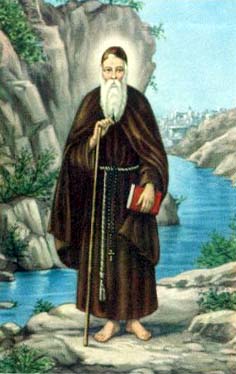
Hermit of the Third Order of St. Francis, date of birth uncertain; died at Noto in Sicily, 19 February, 1351. He belonged to one of the noblest families of Piacenza, and having married when he was quite young, led a virtuous and God-fearing life. On one occasion, when he was engaged in his usual pastime of hunting, he ordered his attendants to fire some brushwood in which game had taken refuge. The prevailing wind caused the flames to spread rapidly, and the surrounding fields and forest were soon in a state of conflagration. A mendicant, who happened to be found near the place where the fire had originated, was accused of being the author. He was imprisoned, tried, and condemned to death.

As the poor man was being led to execution, Conrad, stricken with remorse, made open confession of his guilt; and in order to repair the damage of which he had been the cause, was obliged to sell all his possessions. Thus reduced to poverty, Conrad retired to a lonely hermitage some distance from Piacenza, while his wife entered the Order of Poor Clares. Later he went to Rome, and thence to Sicily, where for thirty years he lived a most austere and penitential life and worked numerous miracles. He is especially invoked for the cure of hernia. In 1515 Leo X permitted the town of Noto to celebrate his feast, which permission was later extended by Urban VIII to the whole Order of St. Francis. Though bearing the title of saint, Conrad was never formally canonized. His feast is kept in the Franciscan Order on 19 February.
STEPHEN M. DONOVAN (Catholic Encyclopedia)

Friday, February 7, 2014


Audio sermon for the feast of the Purification.
Christ is the Light of the world. To truly love is to be self-sacrificing as He is. Once we see God with the eyes of faith we will be tired of this world and be ready to sacrifice all for Him. We will be eager to be dismissed from this world as Simeon was. All the suffering and sacrifice of this world will be considered as nothing once we enjoy the blessing of being with God.

Let us strive to see Christ with the faith and eyes that Simeon had. Just as He was hidden in Human form, yet Simeon saw and believed; so He is hidden in the Holy Eucharist for us to see and believe.

THE ROMAN CATHOLIC CHURCH

Her Doctrine and Morals

Fifth Sunday after the Epiphany

9 February 2014

[Image]

The Sunday

Sermon


Dear Friend,
The evil in this world is permitted by God for two principle reasons. First, God has given us a free will and He honors it even when we use it wrongly. Secondly, God is able in His infinite wisdom and power to make greater good come from the evil He has allowed.
Man has been given a great gift from God in his free will. With our free will we have been placed above all the rest of the physical creation. All the rest of the physical universe is without a free will and acts, through necessity, according to its nature. Love is the giving of our will to another. Consequently only man has the capacity to love. The other lesser creatures may possess affection, but they do not have a free will and therefore cannot truly love. Accordingly, man is the only physical creature that can hate or put his will in opposition to another.
The free will therefore has become a two-edged sword. It is given to man so that he can unite his will freely with God's and thus be capable of love. Man however is also free to refuse this union and love and thus bring sin and evil into the world. Because men are not isolated beings but members of one large family, we see that one man's sin affects not only himself but also the rest of men. The cumulative sins of individual men bring a corresponding evil upon the entire body of mankind. We therefore all suffer the consequences of one another's sins and in this way evil is brought into our lives; even though we may be innocent of a particular sin. God allows this evil because He desires us to have a free will and to be able to love Him, which is a greater good than the permitted evil.
When God allows suffering, pain, or sorrow to enter into our lives, it is because He desires to give us even greater good things. The evil that we have to suffer from time to time is a good thing because it gives us the opportunity to do penance for our sins; and it gives us the opportunity to lovingly take up our cross and follow Jesus. What God takes away from us, He replaces with much greater things (If we will cooperate with Him).
The evils of this world are a constant reminder to us that we are not made for this world. We are only passing through this world. This world is not our home. Without the difficulties of this life, we would soon grow complacent and never seek a better life in heaven. We should therefore, give thanks to God for everything we receive: both the good and the bad. If God gives us riches, or poverty; health or sickness; etc. we must realize that it is all for our ultimate good, and always offer Him praise and thanksgiving. In this way, everything becomes good for us. All things work for the good of those who love God.
Today's Gospel also reminds us to be patient with the evils that He allows to befall us. We must bear patiently the burdens that others impose upon us. Those who today are evil and cause us great pain or suffering, may tomorrow turn out to be one of the greatest of penitents. They also give us the opportunity to grow in grace through the practice of the virtue of patience.
It is possible that an evil man is permitted to live because he is of benefit to someone whom God loves. Evil men in this way provide a good to the rest of society even against their own wills. It is also possible for an evil man have children that will be good. Many times the goodness of one generation greatly outweighs the evil of the other generation. Many of the saints were born to Pagan parents. Some of the great martyrs of the Church were sent to Heaven by their own Pagan parents. The persecutors of the martyrs intended a great evil (the destruction of the Church and faith in Christ), but God drew from this a much greater good and blessing. The martyrs went to eternal happiness in Heaven, and the Church here on earth was given another saint and intercessor in Heaven.
We face the problem of evil in the world every day. The devils want us to focus our attention upon the evil rather than the goodness that God draws from it, or the justness of it as a punishment for sin. We must constantly remind ourselves that there is no evil for those who love God. If we truly love God and unite our wills with His, we will receive eagerly and lovingly whatever divine providence sends our way. The apparent injustices in this life will be perfectly balanced out in eternity. Heaven will be opened up for only those who have used their free will to love God and have avoided using their free will to oppose His will.


ALL THREE OF HIS CHILDREN ARE CANONIZED SAINTS!

February 7 – Saintly King, and Father of Three More Saints

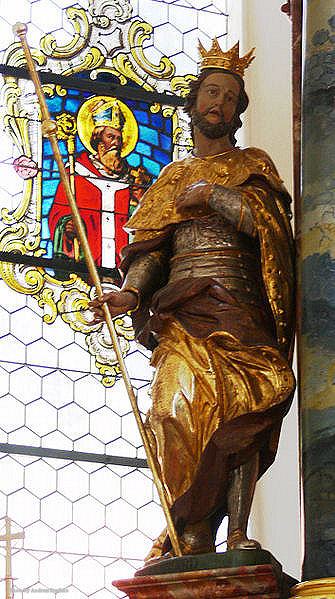
St. Richard, King and Confessor

St. RichardThis saint was an English prince, in the kingdom of the West-Saxons, and was perhaps deprived of his inheritance by some revolution in the state: or he renounced it to be more at liberty to dedicate himself to the pursuit of Christian perfection.
His three children, Winebald, Willibald, and Warburga, are all honored as saints. Taking with him his two sons, he undertook a pilgrimage of penance and devotion, and sailing for Hamblehaven, landed in Neustria on the Western coasts of France.
His daughter, St. Walburga, who became abbess of the monastery founded by her brother St. Willibald. The little vials represent the collected oil that secretes from her bones.
He made a considerable stay at Rouen, and made his devotions in the most holy places that lay in his way through France. Being arrived at Lucca in Italy, in his road to Rome, he there died suddenly, about the year 722, and was buried in St. Fridian’s church there.
His relics are venerated to this day in the same place, and his festival kept at Lucca with singular devotion.St. Richard
St. Richard, when living, obtained by his prayers the recovery of his younger son Willibald, whom he laid at the foot of a great crucifix erected in a public place in England, when the child’s life was despaired of in a grievous sickness: and since his death, many have experienced the miraculous power of his intercession with God, especially where his relics invite the devotion of the faithful.
His festival is kept at Lucca, and his name honored in the Roman Martyrology on the 7th of February.

Friday, January 31, 2014

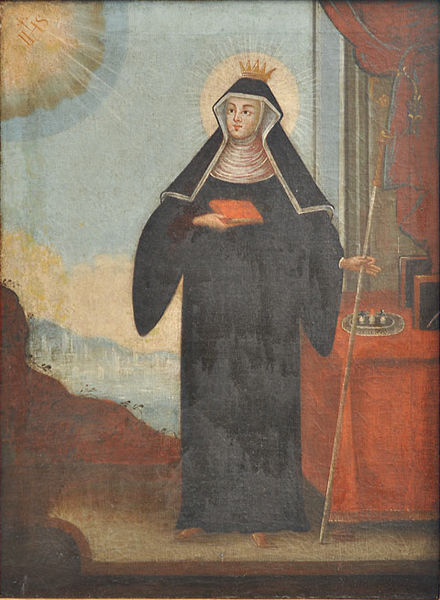
St. Hyacintha Mariscotti

A religious of the Third Order of St. Francis and foundress of the Sacconi; born 1585 of a noble family at Vignanello, near Viterbo in Italy; died 30 January, 1640, at Viterbo; feast, 30 January; in Rome, 6 February (Diarium Romanum).
St. Hyacintha
Her parents were Marc’ Antonio Mariscotti (Marius Scotus) and Ottavia Orsini. At Baptism she received the name Clarice and in early youth was remarkable for piety, but, as she grew older, she became frivolous, and showed a worldly disposition, which not even the almost miraculous saving of her life at the age of seventeen could change; neither was her frivolity checked by her education at the Convent of St. Bernardine at Viterbo, where an older sister had taken the veil. At the age of twenty she set her heart upon marriage with the Marquess Cassizucchi, but was passed by in favour of a younger sister. She was sadly disappointed, became morose, and at last joined the community at St. Bernardine, receiving the name Hyacintha. But, as she told her father, she did this only to hide her chagrin and not to give up the luxuries of the world; and she asked him to furnish her apartments with every comfort. She kept her own kitchen, wore a habit of the finest material, received and paid visits at pleasure.
St. Hyacintha
For ten years she continued this kind of life, so contrary to the spirit of her vows and such a source of scandal to the community. By the special protection of God, she retained a lively faith, was regular in her devotions, remained pure, always showed a great respect for the mysteries of religion, and had a tender devotion to the Blessed Virgin. At length she was touched by God’s grace, and the earnest exhortations of her confessor at the time of serious illness made her see the folly of the past and brought about a complete change in her life. She made a public confession of her faults in the refectory, discarded her costly garments, wore an old habit, went barefoot, frequently fasted on bread and water, chastised her body by vigils and severe scourging, and practised mortifications to such an extent that the decree of canonization considers the preservation of her life a continued miracle. She increased her devotion to the Mother of God, to the Holy Infant Jesus, to the Blessed Eucharist, and to the sufferings of Christ. She worked numerous miracles, had the gifts of prophecy and of discerning the secret thoughts of others. She was also favoured by heavenly ecstacies and raptures. During an epidemic that raged in Viterbo she showed heroic charity in nursing the sick. She established two confraternities, whose members were called Oblates of Mary or Sacconi. One of these, similar to our Society of St. Vincent de Paul, gathered alms for the convalescent, for the poor who were ashamed to beg, and for the care of prisoners; the other procured homes for the aged. Though now leading a life so pure and holy, Hyacintha always conceived the greatest contempt for herself. At her death great sorrow was felt at Viterbo and crowds flocked to her funeral. She was beatified by Pope Benedict XIII in 1726, and canonized 14 May, 1807, by Pius VII.

Wednesday, January 29, 2014

CHAPTER XIX
HOW THE VINE OF THE PRIEST OF RIETI, WHOSE HOUSE ST FRANCIS ENTERED TO PRAY, WAS TRAMPLED UNDER FOOT BY THE GREAT NUMBERS WHO CAME TO SEE HIM, AND HOW IT YET PRODUCED A GREATER QUANTITY OF WINE THAN USUAL, AS ST FRANCIS HAD PROMISED; AND HOW THE LORD REVEALED TO THE SAINT THAT HEAVEN WOULD BE HIS PORTION WHEN HE LEFT THIS WORL
D
St Francis at one time being grievously tormented with a disease in his eyes, the Cardinal Ugolino, protector of his Order, who loved him dearly, wrote to him to come to Rieti, where there were excellent oculists. St Francis, having received the Cardinal's letter, set off first to San Damiano, where was Sister Clare, the devout spouse of Christ, to give her some spiritual consolation, intending afterwards to go on to the Cardinal. On arriving at San Damiano, the following night his eyes grew so much worse that he could not see the light, and was obliged to give up going any further. Then Sister Clare made him a little cell of reeds, in order that he might repose the better; but St Francis, owing partly to the pain he suffered, and partly to the multitude of rats, which much annoyed him, could rest neither day or night. After suffering for several days this pain and tribulation, he began to think that it was sent to him by God as a punishment for his sins, and he thanked the Lord in his heart and with his lips, crying out with a loud voice: "My God, I am worthy of this, and even worse. My Lord Jesus Christ, thou Good Shepherd, who hast shown thy mercy to us poor sinners in the various bodily pains and sufferings it pleaseth thee to send us; grant to me, thy little lamb, that no pain, however great, no infirmity nor anguish, shall ever separate me from thee." Having made this prayer, a voice came from heaven, which said: "Francis, if all the earth were of gold, if all the seas and all the fountains and all the rivers were of balm, if all mountains, all hills, and all rocks were made of precious stones, and if thou couldst find a treasure as much more precious again as gold is more precious than earth, and balm than water, and gems than mountains and rocks, if that precious treasure were offered to thee in the place of thy infirmity, wouldst thou not rejoice and be content?" St Francis answered: "Lord, I am unworthy of such a treasure." And the voice of God said again: "Rejoice with all thy heart, Francis, for such a treasure is life eternal, which I have in keeping for thee, and even now promise to thee; and this thine infirmity and affliction is a pledge of that blessed treasure." Then was St Francis filled with joy at so glorious a promise; and calling his companion, he said to him: "Let us go to the Cardinal." He humbly took leave of Sister Clare, after having comforted her with holy words, and took the road to Rieti. When he approached the town, such a multitude came out to meet him, that he would not go into the city, but went to a church which was about two miles of. But the people, hearing where he was gone, went thither to see him; so that the vine which surrounded the church was greatly injured, and all the grapes were gathered; at which the priest, to whom it belonged, was very grieved in his heart, and repented of having received St Francis in his church. The thought of the priest being revealed to the saint, he called him to him and said: "Dearest father, tell me, how many measures of wine does this vine produce when the year is a fertile one?" He answered: "Twelve measures." Then said St Francis: "I pray thee, father, have patience and endure my presence here a few days longer, as I find great rest in this church; and, for the love of God and of me his poor servant, let the people gather the grapes off thy vine; for I promise thee, in the name of my Saviour Jesus Christ, that it shall produce every year twenty measures of wine." And St Francis remained there for the benefit of the souls of all who went to see him, for many went away filled with divine love, and gave up the world. The priest, having faith in the promise of St Francis, left the vineyard open to all those who came to see him. And, wonder of wonders! although the vine was entirely ruined, so that there scarcely remained, here and there, a few small bunches of grapes, when the time of vintage arrived, the priest gathered the few bunches which were left, and put them into the winepress; and according to the promise of St Francis, these few little bunches did not fail to produce twenty measures of excellent wine. This miracle teaches us that as, in consequence of the merits of St Francis, the vine, though despoiled of its grapes, produced an abundance of wine, so in the same way many Christians, whose sins had made them barren of virtue, through the saint's preaching and merits, have often come to abound in the good fruit of repentance.

Monday, January 20, 2014

Audio sermon for the Second Sunday after the Epiphany Our Lord's first public miracle signals the end of the Old Testament and the beginning of the New. The old wine has run out and God has given us a new wine in the New Covenant. This new Covenant is far superior to the Old one.
Audio Sermon for The Feast of The Holy Family The family is the basic unit of all civilization and is in the image and likeness of God and is therefore under direct assault from the devils. We must defend the family with
constant loving sacrifice, if we are to avoid the snares placed before us by the world, the devils and our own fallen nature.
Audio Sermon given Saturday January 11. Understanding the problem of evil in the world. Answering the question: Why is their evil in the world, while God is all good, all powerful, all merciful, etc.