Pageviews last month

Saturday, September 7, 2019


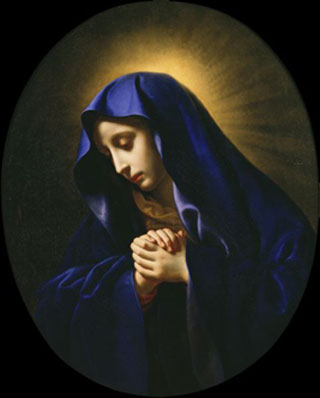
Image result for sorrowful mother images


The Mother of God once said to her faithful servant St. Bridget: "No matter how
numerous a person's sins may be, if he turns to me with a sincere purpose of
amendment I am prepared forthwith to receive him graciously, for I do not regard the
number of sins he has committed, but look only upon the dispositions with which he
comes to me; for I feel no aversion in healing his wounds, because I am called and am in truth the Mother of Mercy."

"Poor abandoned sinners," exclaims St. Alphonsus Liguori, "do not despair! Raise your eyes to Mary and be comforted, trusting in the clemency of this good Mother. For she will rescue you from the shipwreck you have suffered and conduct you to the haven of salvation."

Monday, September 2, 2019

Image result for good samaritan images


What is understood from this day's gospel, the Good Samaritan,  in a higher and more spiritual sense?

According to the interpretation of the Fathers, our father Adam, and hence the whole human race is to be understood by the one who had fallen among robbers. The human race, which through the disobedience of Adam fell into the power of Satan and his angels, was robbed of original justice and the grace of God, and moreover, was wounded and weakened in all the powers of the soul by evil concupiscence. The priest and The Levite who represent the Old Law, would not and could not repair this misfortune; but Christ, the true Samaritan, embraced the interests of the wounded man, inasmuch as He poured the oil of His grace, and the wine of His blood into the wounds of man's soul, and thus healed him, and inasmuch as He led him by baptism into the inn of His Church, and there entrusted him to His priests for further care and nursing. Thank Christ, the good Samaritan, for this great love and care for you, and endeavor to make good use of His blessings by your cooperation.

-GOFFINE'S DEVOUT INSTRUCTIONS, 1896

Saturday, August 31, 2019

Image result for st raymond nonnatus


St. Raymond Nonnatus
Raymond became a priest due to his quiet persistence in prayer and study.

He was born to a noble Spanish family in 1204. His mother died during child birth and his father had high expectations for Raymond to serve in the country’s Royal Court.  However, the young Raymond felt drawn to religious life. In an attempt to dissuade him, his father ordered him to manage one of the family farms. However, Raymond spent his time with the workers, studying, and praying. His father finally gave up and allowed Raymond to enter the Mercederians.

Fr. Raymond spent his entire estate ransoming slaves. He even offered himself as a hostage to free another. He was sentenced to death but was spared because his ransom would bring in a large amount of money.

During his imprisonment, he succeeded at converting some of his guards. To keep him from continuing his preaching, his captors bored a hole through his lips with a hot iron, and attached a padlock. He was eventually ransomed, and he returned to Barcelona in 1239.

That year, he was named a cardinal by Pope Gregory IX.  The following year, in 1240, he was summoned to Rome, but barely made it out of Barcelona before he died at the age of 36.

St. Raymond is the patron saint of pregnant women, childbirth, and newborn infants.

Thursday, August 22, 2019


Thank you to Our Lady of Victory School for this meme!

Thursday, August 15, 2019

Image result for Assumption of mary images


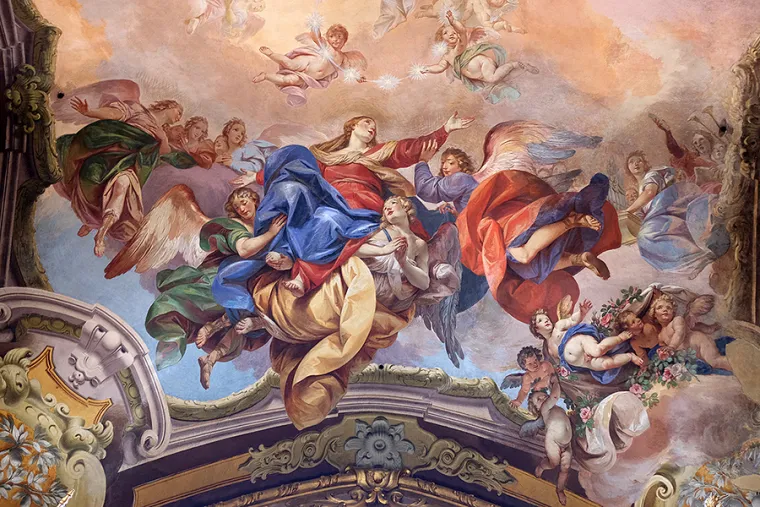
THOUGHTS OF ST. BERNARD ON THE ASSUMPTION OF MARY
On this day the glorified Virgin entered heaven and crowned by her presence the holy
pleasures of its inhabitants. But what mind can conceive the glory with which the
arrival of the Queen of the world was celebrated by the brilliant heavenly hosts,
their advance to greet her, their chanting as they led her to the magnificent throne?
Who can fancy the tender gaze, the loving countenance, the divine caresses with which
she was received by her Son and placed over all created beings, honored as became
such a mother, with the glory that became such a Son? What lips can describe the
assumption of Mary? As upon earth she, before all others, received special grace, so
in heaven she, before all others, receives special glory. If eye hath not seen, nor
ear heard, nor hath it entered into the heart of man to know the delights that God
has prepared for those that love Him, who shall say what is prepared for her who bore
Him and loved Him more than all! O blessed art thou, Mary! Most blessed wert thou,
when thou didst receive the Saviour; most blessed art thou, when the Saviour receives
thee!

ST. BERNARD'S PRAYER TO MARY
We accompany thee, on this day, with our most ardent wishes to thy Son, O glorious
Virgin, Queen of heaven! and follow thee from afar, O happy Virgin! Give thy mildness
to the world, give of the grace thou hast found with God. Obtain by thy blessed
intercession, grace for the guilty, recovery for the sick, strength for the
faint-hearted, aid for those in peril! Dispense to us thy servants, who on this
glorious festival-day invoke thy sweetest name, O gentlest Queen, the grace of Jesus
Christ, thy Son, our Lord and God, to whom be glory forever. Amen.
Friday, July 19, 2019

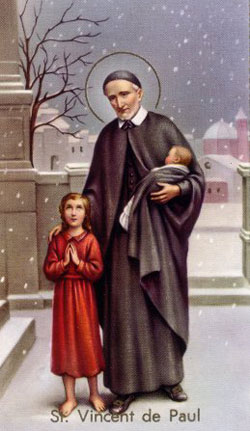
Image of St. Vincent de Paul


ST VINCENT DE PAUL
St. Vincent de Paul was born to a poor peasant family in the French village of Pouy on April 24, 1581. His first formal education was provided by the Franciscans. He did so well, he was hired to tutor the children of a nearby wealthy family. He used the monies he earned teaching to continue his formal studies at the University of Toulose where he studied theology.
He was ordained in 1600 and remained in Toulose for a time. In 1605, while on a ship traveling from Marseilles to Narbone, he was captured, brought to Tunis and sold as a slave. Two years later he and his master managed to escape and both returned to France.
St. Vincent went to Avignon and later to Rome to continue his studies. While there he became a chaplain to the Count of Goigny and was placed in charge of distributing money to the deserving poor. He became pastor of a small parish in Clichy for a short period of time, while also serving as a tutor and spiritual director.
From that point forward he spent his life preaching missions to and providing relief to the poor. He even established hospitals for them. This work became his passion. He later extended his concern and ministry to convicts. The need to evangelize and assist these souls was so great and the demands beyond his own ability to meet that he founded the Ladies of Charity, a lay institute of woman, to help, as well as a religious institute of priests - the Congregation of Priests of the Mission, commonly referred to now as the Vincentians.
This was at a time when there were not many priests in France and what priests there were, were neither well-formed nor faithful to their way of life. Vincent helped reform the clergy and the manner in which they were instructed and prepared for the priesthood. He did this first through the presentation of retreats and later by helping develop a precursor to our modern day seminaries. At one point his community was directing 53 upper level seminaries. His retreats, open to priests and laymen, were so well attended that it is said he infused a "Christian spirit among more than 20,000 persons in his last 23 years."
He was eighty years old when he died in Paris on September 27, 1660.He had "become the symbol of the successful reform of the French Church". St. Vincent is sometimes referred to as "The Apostle of Charity" and "The Father of the Poor".
His incorrupt heart can be found in the Convent of the Sisters of Charity and his bones have been embedded in a wax effigy of the Saint located at the Church of the Lazarist Mission. Both sites are located in Paris, France.
Two miracles have been attributed to St Vincent - a nun cured of ulcers and a laywoman cured of paralysis. As a result of the first, Pope Benedict XIII beatified him on August 13, 1729. Less than 8 years later (on June 16, 1737) he was canonized by Pope Clement XIII. The Bull of Canonization recognized Vincent for his charity and reform of the clergy, as well as for his early role in opposing Jansenism.
It has been reported that St. Vincent wrote more than 30,000 letters in his lifetime and that nearly 7,000 had been collected in the 18th century. There are at least five collections of his letters in existence today.