Pageviews last month

Thursday, October 19, 2017


BATTLE OF LEPANTO, 1571 - On Sunday, October 7, the Christian and Turkish
fleets met in Lepanto Gulf, off the coast of Greece. The bitter battle
finished with a brilliant victory of the Christians who where vastly
outnumbered. That very evening Pope St. Pius V had at Rome a clear
knowledge of this success. The same afternoon, the Confraternities of the
Rosary, particularly in Rome, had marched through the streets in procession
reciting the Rosary. This victory put an end to the naval power of the
Turks and saved Christian Europe. To this day this victory has been
attributed to the praying of the Rosary. The feast of “The Most Holy
Rosary” is celebrated on October 7 now and the month of October is
dedicated to the Most Holy Rosary.

Sunday, October 15, 2017


St. Dominic prayed to Our Lady that she would force the devils who
possessed a man to reveal the truth about devotion to her. The devils were
forced by Our Lady to reveal: "Now that we are forced to speak we must also
tell you this: Nobody who perseveres in saying the Rosary will be damned,
because she obtains for her servants the grace of true contrition for their
sins and by means of this they obtain God's forgiveness and mercy."

Wednesday, October 11, 2017


THE COUNTRY THAT SAVED ITSELF - Brazil 1962 - In 1962 there was a looming
threat of communist takeover in Brazil. A woman there named Dona Amelia
Bastos was known to have formed a Rosary rally among the Brazilian women
there to do their part in opposing the looming threat. Their goal was
simply to pray the Rosary in large groups asking the Virgin Mary for help
in opposing the Communist takeover which the President of Brazil was
leaning toward at the time. In Belo Horizonte 20,000 women reciting the
rosary aloud broke up a Communist rally. In Sao Paulo, 600,000 women
praying the rosary in one of the most moving demonstrations in Brazilian
history, caused the President of Brazil to flee the country and not a
single death was encountered, sparing the country from Communist takeover.

Tuesday, October 10, 2017


The most holy Virgin in these last times in which we live has given a new
efficacy to the recitation of the Rosary to such an extent that there is no
problem, no matter how difficult it is, whether temporal or, above all,
spiritual, in the personal life of each one of us, of our families, of the
families of the world, or of the religious communities, or even of the life
of peoples and nations, that cannot be solved by the Rosary. There is no
problem, I tell you, no matter how difficult it is, that we cannot resolve
by the prayer of the holy Rosary. With the holy Rosary, we will save
ourselves; we will sanctify ourselves; we will console our Lord, and obtain
the salvation of many souls.
Conversation between Sr. Lucy of Fatima and Fr. Fuentes, Dec. 26, 1957

Friday, October 6, 2017


The Rosary is a powerful weapon to put the demons to flight and to keep
oneself from sin…If you desire peace in your hearts, in your homes, and
in your country, assemble each evening to recite the Rosary. Let not even
one day pass without saying it, no matter how burdened you may be with many
cares and labors." Pope Pius XI

Tuesday, October 3, 2017


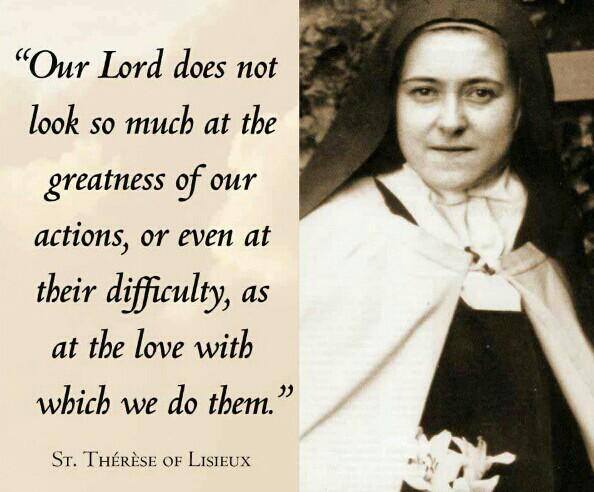
True Charity consists in bearing with all the defects of our neighbor, in not being surprised at his failings, and in being edified by his least virtues; Charity must not remain shut up in the depths of the heart, for no man lighteth a candle and putteth it under a bushel, but upon a candlestick, that it may shine to all that are in the house. (Cf. Matthew 5:15). It seems to me that this candle represents the Charity which ought to enlighten and make joyful, not only those who are dearest to me, but all who are in the house.🌹🌹🌹
Story of A Soul, Chapter IX

Tuesday, September 26, 2017


Saints Isaac Jogues, Jean de Brébeuf, and Companions’ Story

Isaac Jogues and his companions were the first martyrs of the North American continent officially recognized by the Church. As a young Jesuit, Isaac Jogues, a man of learning and culture, taught literature in France. He gave up that career to work among the Huron Indians in the New World, and in 1636, he and his companions, under the leadership of Jean de Brébeuf, arrived in Quebec. The Hurons were constantly warred upon by the Iroquois, and in a few years Father Jogues was captured by the Iroquois and imprisoned for 13 months. His letters and journals tell how he and his companions were led from village to village, how they were beaten, tortured, and forced to watch as their Huron converts were mangled and killed.
An unexpected chance for escape came to Isaac Jogues through the Dutch, and he returned to France, bearing the marks of his sufferings. Several fingers had been cut, chewed, or burnt off. Pope Urban VIII gave him permission to offer Mass with his mutilated hands: “It would be shameful that a martyr of Christ not be allowed to drink the Blood of Christ.”
Welcomed home as a hero, Father Jogues might have sat back, thanked God for his safe return, and died peacefully in his homeland. But his zeal led him back once more to the fulfillment of his dreams. In a few months he sailed for his missions among the Hurons.
In 1646, he and Jean de Lalande, who had offered his services to the missioners, set out for Iroquois country in the belief that a recently signed peace treaty would be observed. They were captured by a Mohawk war party, and on October 18, Father Jogues was tomahawked and beheaded. Jean de Lalande was killed the next day at Ossernenon, a village near Albany, New York.
The first of the Jesuit missionaries to be martyred was René Goupil who with Lalande, had offered his services as an oblate. He was tortured along with Isaac Jogues in 1642, and was tomahawked for having made the sign of the cross on the brow of some children.
Jean de Brébeuf was a French Jesuit who came to Canada at the age of 32 and labored there for 24 years. He went back to France when the English captured Quebec in 1629 and expelled the Jesuits, but returned to his missions four years later. Although medicine men blamed the Jesuits for a smallpox epidemic among the Hurons, Jean remained with them.
He composed catechisms and a dictionary in Huron, and saw 7,000 converted before his death. He was captured by the Iroquois and died after four hours of extreme torture at Sainte Marie, near Georgian Bay, Canada.
Father Anthony Daniel, working among Hurons who were gradually becoming Christian, was killed by Iroquois on July 4, 1648. His body was thrown into his chapel, which was set on fire.
Gabriel Lalemant had taken a fourth vow—to sacrifice his life for the Native Americans. He was horribly tortured to death along with Father Brébeuf.
Father Charles Garnier was shot to death as he baptized children and catechumens during an Iroquois attack.
Father Noel Chabanel was killed before he could answer his recall to France. He had found it exceedingly hard to adapt to mission life. He could not learn the language, and the food and life of the Indians revolted him, plus he suffered spiritual dryness during his whole stay in Canada. Yet he made a vow to remain until death in his mission.
These eight Jesuit martyrs of North America were canonized in 1930.