Bishop Giles OFM
Friday, September 11, 2015
We see the vast number of non-Christians lost; we
see the vast number of sects separated from the Catholic Church is
likewise lost. The Holy Ghost only dwells in the Catholic Church.
Outside of Her there is no salvation. But, how many who are within the
Church will be saved? How many can truly say that they love Christ, and
they can attest to it by their actions (keeping His word)?

Monday, September 7, 2015
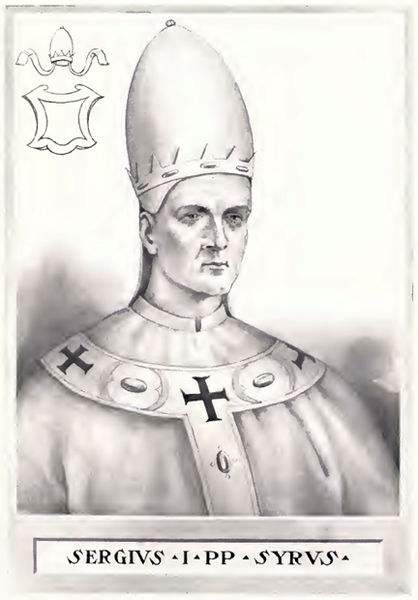
Pope St. Sergius I
(Reigned 687-701), date of birth unknown; consecrated probably on 15 Dec., 687; died 8 Sept., 701.While Pope Conon lay dying, the archdeacon Pascal offered the exarch a large sum to bring about his election as his successor. Through the exarch’s influence the archdeacon was accordingly elected by a number of people; about the same time another faction elected the archpriest Theodore. The mass of clergy and people, however, set them both aside and chose Sergius, who was duly consecrated.
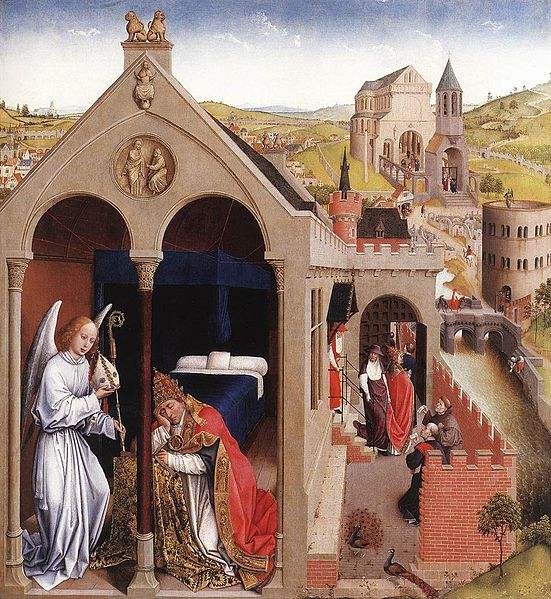
Dream of Pope St. Sergius, painting by Rogier van der Weyden
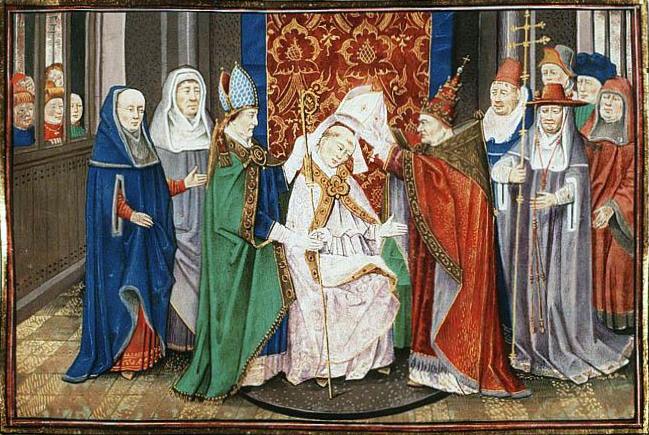 St Hubert of Liège is consecrated bishop by Pope St. Sergius.
The cruel Emperor Justinian wanted him to sign the decrees of the so- called Quinisext or Trullan Council of 692, in which the Greeks allowed priests and deacons to keep the wives they had married before their ordination, and which aimed at placing the Patriarch of Constantinople on a level with the Pope of Rome. When Sergius refused to acknowledge this synod, the emperor sent an officer to bring him to Constantinople. But the people protected the pope, and Justinian himself was soon afterwards deposed (695).
Liber Pontificalis, ed. DUCHESNE, I (Paris, 1886), 371 sqq.; HEFELE, Hist. of the Councils, V (tr., Edinburgh, 1894), 221 sqq.; BEDE, Hist. eccles., V; PAULUS DIACONUS, De gest. Langob., VI; HODGKIN, Italy and Her Invaders, VI (Oxford, 1895), 352 sqq.; MANN, Lives of the Popes, I (London, 1902), ii, 77 sqq.
Horace K. Mann (Catholic Encyclopedia)
Saturday, September 5, 2015
Mary is the queen of Martyrs, for her Martyrdom was longer and greater than
that of all the Martyrs.
 Who can ever have a heart so hard that it will not melt on hearing the most
lamentable event that once occurred in the world? There was a noble and
holy mother who had an only son. This son was the most amiable that can be
imagined - innocent, virtuous, beautiful, who loved his mother most
tenderly; so much so that he had never caused her the least displeasure,
but had ever shown her all respect, obedience, and affection; hence this
mother had placed her affections on earth in this son. Hear, then, what
happened. This son, through envy, was falsely accused by his enemies; and
though the judge knew, and himself confessed, that he was innocent, yet,
that he might not offend his enemies, he condemned him to the ignominious
death that they demanded. This poor mother had to suffer the grief of
seeing that amiable and beloved son unjustly snatched from her in the
flower of his age by a barbarous death; for, by dint of torments and
drained of all his blood, he was made to die on an infamous gibbet in a
public place of execution, and this before her own eyes. Devout souls, what
say you? Is not this event, and is not this unhappy mother, worthy of
compassion? You already understand of whom I speak. This son, so cruelly
executed, was our loving Redeemer Jesus; and this mother was the Blessed
Virgin Mary; who, for the love she bore us, was willing to see him
sacrificed to divine justice by the barbarity of men. This great torment
which Mary endured for us - a torment that was more than a thousand deaths
- deserves both our compassion and our gratitude. If we can make no other
return for so much love, at least let us give a few moments this day to
consider the greatness of the sufferings by which Mary became the Queen of
martyrs; for the sufferings of her great martyrdom exceeded those of all
the martyrs; being, in the first place, the longest in point of duration;
and in the second place, the greatest in point of intensity.
From "Victories of the Martyrs"
By St. Alphonsus Liguori
Saturday, August 29, 2015
 Mary adorns her clients with
her merits, assists them with her power, enlightens them with her
light, and kindles them with her love. She imparts her virtues to them
and becomes their security, their intercessor, and their all with Jesus.
Mary adorns her clients with
her merits, assists them with her power, enlightens them with her
light, and kindles them with her love. She imparts her virtues to them
and becomes their security, their intercessor, and their all with Jesus.Tuesday, August 25, 2015

Saturday, August 22, 2015
Faith without works is dead James 2:24

True religion consists of these two elements: pious doctrines and virtuous actions. God does not accept doctrines apart from good works, nor are works, when divorced from godly doctrines, accepted by God. What does it profit a man to be an expert theologian if he is a shameless fornicator; or to be nobly self-controlled, but an impious blasphemer?
St. Cyril of Jerusalem (315-386AD) on Faith and Works
How can a man say he believes in Christ if he doesn't do what Christ commanded him to do?St. Cyprian of Carthage (200-258AD) on Faith and Works
True religion consists of these two elements: pious doctrines and virtuous actions. God does not accept doctrines apart from good works, nor are works, when divorced from godly doctrines, accepted by God. What does it profit a man to be an expert theologian if he is a shameless fornicator; or to be nobly self-controlled, but an impious blasphemer?
St. Cyril of Jerusalem (315-386AD) on Faith and Works
How can a man say he believes in Christ if he doesn't do what Christ commanded him to do?St. Cyprian of Carthage (200-258AD) on Faith and Works
Friday, August 7, 2015
70th Anniversary of the Amazing Hiroshima Eight

Hiroshima before the bombing.
As one single bomb neared the ground, a city died in an instant. Houses crumbled, people evaporated, an immense ball of fire shot skywards, and a terrible wave of super-heated gas bulged out from ground zero, flattening buildings for miles.
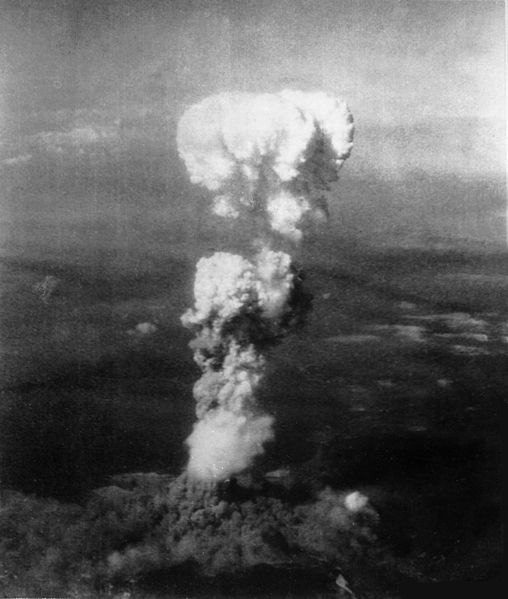
Atomic
cloud over Hiroshima. The cloud rose to over 60,000 feet in about ten
minutes, while smoke from the burst of the first atomic bomb had spread
over 10,000 feet at the base of the rising column.
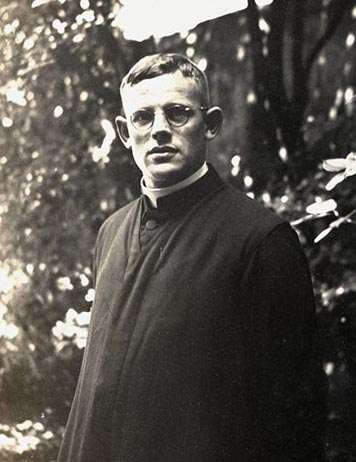
Father John Seimes, S.J., one of the eight Jesuit Fathers that miraculously survived the atomic bombing.

Our Lady of the Assumption Church and the Jesuit Rectory.

Atomic cloud over Nagasaki from Koyagi-jima on August 9, 1945.
After the American conquest of Japan, U.S. army doctors explained to Fr. Schiffer that his body would soon begin to deteriorate because of the radiation. To the doctors’ amazement, Fr. Schiffer’s body showed no radiation or ill effects from the bomb. All who were at this range from the epicenter should have received enough radiation to be dead within a matter of minutes. Scientists examined the group of Hiroshima Jesuits over 200 times during the next 30 years and no ill effects were ever found.
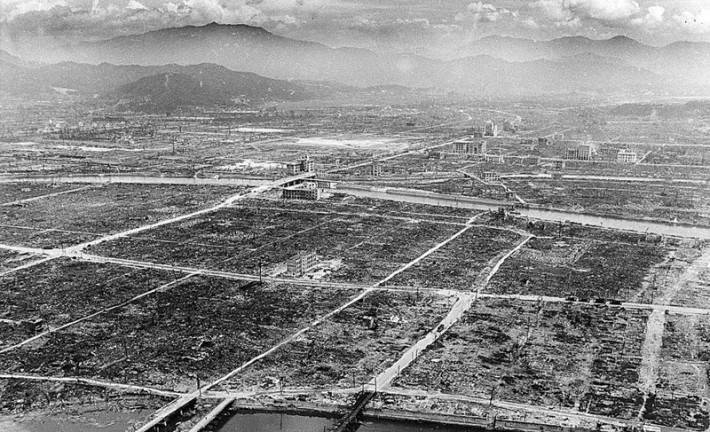
Hiroshima after the bombing
From a scientific standpoint, what happened to those Jesuits at Hiroshima still defies all the laws of physics. It must be concluded that some other force was present, whose power to transform energy and matter as it relates to humans is beyond our comprehension.

Urakami
Cathedral after the bomb. Only 500 feet from the hypocenter of the
blast stood the original Urakami Cathedral, a center for Nagasaki’s
Catholic community. Catholic missionaries first came to Nagasaki in the
16th century, and within several decades hundreds of thousands of people
in Southwestern Japan were practicing Catholics.
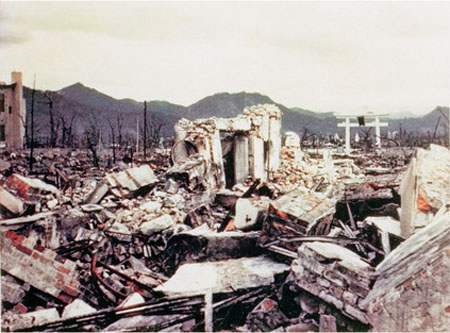
Hypocenter of the blast in Hiroshima was Shima Hospital.
“The Department of Defense never commented officially on this and I suspect it was classified and never discussed in open literature. I think it is possible the Jesuits were asked not to say anything either at the time.”

For God, who made all matter and energy, it is simply a matter of willing it and the laws that govern them are suspended. This is what happened at Hiroshima and Nagasaki. It also happened in ancient times, to the loyal servants of God Sidrach, Misach, and Abdenago, as is related in the Book of Daniel (3:19-24):
“Then was Nebuchodonosor filled with fury: and the countenance of his face was changed against Sidrach, Misach, and Abdenago, and he commanded that the furnace should be heated seven times more than it had been accustomed to be heated. And he commanded the strongest men that were in his army, to bind the feet of Sidrach, Misach, and Abdenago, and to cast them into the furnace of burning fire. And immediately these men were bound and were cast into the furnace of burning fire, with their coasts, and their caps, and their shoes, and their garments. For the king’s commandment was urgent, and the furnace was heated exceedingly. And the flame of the fire slew those men that had cast Sidrach, Misach, and Abdenago. But these three men, that is, Sidrach, Misach, and Abdenago, fell down bound in the midst of the furnance of burning fire. And they walked in the midst of the flame, praising God and blessing the Lord.”
Subscribe to:
Posts (Atom)