Pageviews last month

Thursday, March 6, 2014

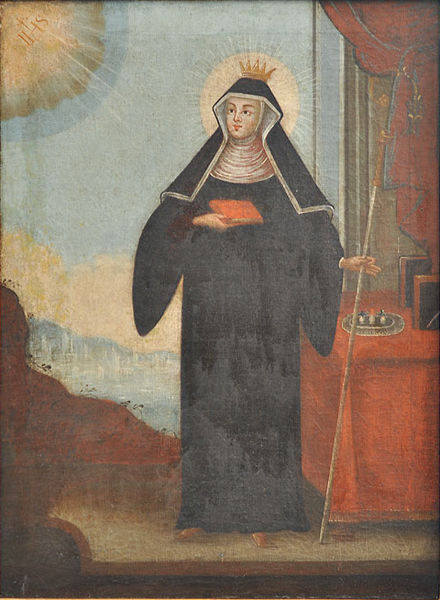
St. Frances of Rome

St. Frances of Rome with her Guardian Angel, who was continually visible to her.
One of the greatest mystics of the fifteenth century; born at Rome, of a noble family, in 1384; died there, 9 March, 1440.
Her youthful desire was to enter religion, but at her father’s wish she married, at the age of twelve, Lorenzo de’ Ponziani. Among her children we know of Battista, who carried on the family name, Evangelista, a child of great gifts (d. 1411), and Ages (d. 1413).
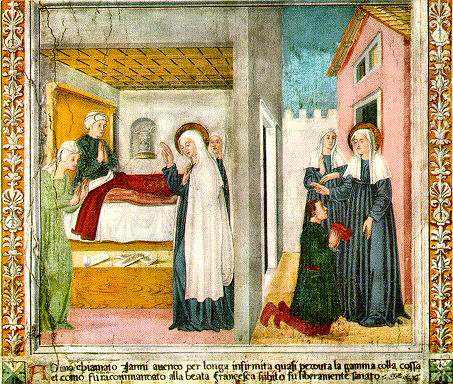
St. Frances curing the gangrenous leg of Janni, who had been ill a long time. On the right, Janni is thanking St. Frances. One of a series of frescoes in the Monastery of Tor de' Specchi in Rome, featuring stories of the life of St. Frances of Rome painted by Antoniazzo Romano.
St. Frances curing the gangrenous leg of Janni, who had been ill a long time. On the right, Janni is thanking St. Frances. One of a series of frescoes in the Monastery of Tor de’ Specchi in Rome, featuring stories of the life of St. Frances of Rome painted by Antoniazzo Romano.
Frances was remarkable for her charity to the poor, and her zeal for souls. She won away many Roman ladies from a life of frivolity, and united them in an association of oblates attached to the White Benedictine monastery of Santa Maria Nuova; later they became the Benedictine Oblate Congregation of Tor di Specchi (25 March, 1433) which was approved by Eugene IV (4 July, 1433). Its members led the life of religious, but without the strict cloister or formal vows, and gave themselves up to prayer and good works.

With her husband’s consent Frances practiced continency, and advanced in a life of contemplation. Her visions often assumed the form of drama enacted for her by heavenly personages. She had the gift of miracles and ecstasy, we well as the bodily vision of her guardian angel, had revelations concerning purgatory and hell, and foretold the ending of the Western Schism. She could read the secrets of consciences and detect plots of diabolical origin. She was remarkable for her humility and detachment, her obedience and patience, exemplified on the occasion of her husband’s banishment, the captivity of Battista, her sons’ death, and the loss of all her property.
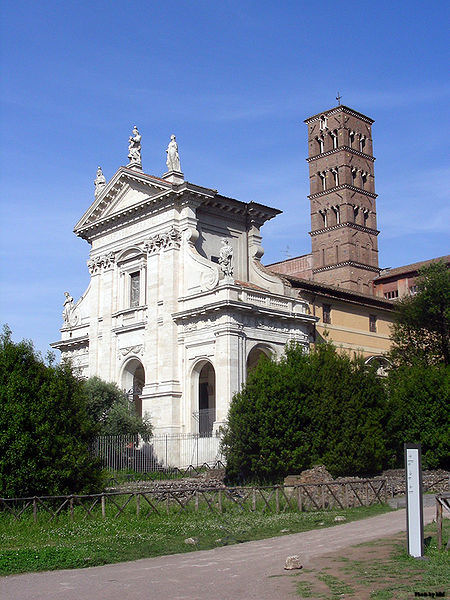
Santa Francesca Romana Church, Rome
On the death of husband (1436) she retired among her Oblates at Tor di Specchi, seeking admission for charity’s sake, and was made superior. On the occasion of a visit to her son, she fell ill and died on the day she had foretold. Her canonization was preceded by three processes (1440, 1443, 1451) and Paul V declared her a saint on 9 May, 1608, assigning 9 March as her feast day. Long before that, however, the faithful were wont to venerate her body in the church of Santa Maria Nuova in the Roman Forum, now known as the church of Santa Francesca Romana.

FRANCESCO PAOLI (Catholic Encyclopedia)

Saturday, March 1, 2014

CHAPTER XXI
OF THE MOST HOLY MIRACLE OF ST FRANCIS IN TAMING THE FIERCE WOLF OF GUBBIO
At the time when St Francis was living in the city of Gubbio, a large wolf appeared in the neighbourhood, so terrible and so fierce, that he not only devoured other animals, but made a prey of men also; and since he often approached the town, all the people were in great alarm, and used to go about armed, as if going to battle. Notwithstanding these precautions, if any of the inhabitants ever met him alone, he was sure to be devoured, as all defence was useless: and, through fear of the wolf, they dared not go beyond the city walls. St Francis, feeling great compassion for the people of Gubbio, resolved to go and meet the wolf, though all advised him not to do so. Making the sign of the holy cross, and putting all his confidence in God, he went forth from the city, taking his brethren with him; but these fearing to go any further, St Francis bent his steps alone toward the spot where the wolf was known to be, while many people followed at a distance, and witnessed the miracle. The wolf, seeing all this multitude, ran towards St Francis with his jaws wide open. As he approached, the saint, making the sign of the cross, cried out: "Come hither, brother wolf; I command thee, in the name of Christ, neither to harm me nor anybody else." Marvelous to tell, no sooner had St Francis made the sign of the cross, than the terrible wolf, closing his jaws, stopped running, and coming up to St Francis, lay down at his feet as meekly as a lamb. And the saint thus addressed him: "Brother wolf, thou hast done much evil in this land, destroying and killing the creatures of God without his permission; yea, not animals only hast thou destroyed, but thou hast even dared to devour men, made after the image of God; for which thing thou art worthy of being hanged like a robber and a murderer. All men cry out against thee, the dogs pursue thee, and all the inhabitants of this city are thy enemies; but I will make peace between them and thee, O brother wolf, is so be thou no more offend them, and they shall forgive thee all thy past offences, and neither men nor dogs shall pursue thee any more." Having listened to these words, the wolf bowed his head, and, by the movements of his body, his tail, and his eyes, made signs that he agreed to what St Francis said. On this St Francis added: "As thou art willing to make this peace, I promise thee that thou shalt be fed every day by the inhabitants of this land so long as thou shalt live among them; thou shalt no longer suffer hunger, as it is hunger which has made thee do so much evil; but if I obtain all this for thee, thou must promise, on thy side, never again to attack any animal or any human being; dost thou make this promise?" Then the wolf, bowing his head, made a sign that he consented. Said St Francis again: "Brother wolf, wilt thou pledge thy faith that I may trust to this thy promise?" and putting out his hand he received the pledge of the wolf; for the latter lifted up his paw and placed it familiarly in the hand of St Francis, giving him thereby the only pledge which was in his power. Then said St Francis, addressing him again: "Brother wolf, I command thee, in the name of Christ, to follow me immediately, without hesitation or doubting, that we may go together to ratify this peace which we have concluded in the name of God"; and the wolf, obeying him, walked by his side as meekly as a lamb, to the great astonishment of all the people. Now, the news of this most wonderful miracle spreading quickly through the town, all the inhabitants, both men and women, small and great, young and old, flocked to the market-place to see St Francis and the wolf. All the people being assembled, the saint got up to preach, saying, amongst other things, how for our sins God permits such calamities, and how much greater and more dangerous are the flames of hell, which last for ever, than the rage of a wolf, which can kill the body only; and how much we ought to dread the jaws of hell, if the jaws of so small an animal as a wolf can make a whole city tremble through fear. The sermon being ended, St Francis added these words: "Listen my brethren: the wolf who is here before you has promised and pledged his faith that he consents to make peace with you all, and no more to offend you in aught, and you must promise to give him each day his necessary food; to which, if you consent, I promise in his name that he will most faithfully observe the compact." Then all the people promised with one voice to feed the wolf to the end of his days; and St Francis, addressing the latter, said again: "And thou, brother wolf, dost thou promise to keep the compact, and never again to offend either man or beast, or any other creature?" And the wolf knelt down, bowing his head, and, by the motions of his tail and of his ears, endeavoured to show that he was willing, so far s was in his power, to hold to the compact. Then St Francis continued: "Brother wolf, as thou gavest me a pledge of this thy promise when we were outside the town, so now I will that thou renew it in the sight of all this people, and assure me that I have done well to promise in thy name"; and the wolf lifting up his paw placed it in the hand of St Francis. Now this event caused great joy in all the people, and a great devotion towards St Francis, both because of the novelty of the miracle, and because of the peace which had been concluded with the wolf; and they lifted up their voices to heaven, praising and blessing God, who had sent them St Francis, through whose merits they had been delivered from such a savage beast. The wolf lived two years at Gubbio; he went familiarly from door to door without harming anyone, and all the people received him courteously, feeding him with great pleasure, and no dog barked at him as he went about. At last, after two years, he died of old age, and the people of Gubbio mourned his loss greatly; for when they saw him going about so gently amongst them all, he reminded them of the virtue and sanctity of St Francis.

THE ROMAN CATHOLIC CHURCH

Her Doctrine and Morals

Quinquagesima Sunday

2 March 2014

[Image]

The Sunday

Sermon


Dear Friend,
Today we are encouraged to consider the blind man by the wayside. This blind man represents all sinful men. Our sins have blinded us to the light of God and to all truth. But, only those who acknowledge or recognize their own blindness will pray for light and sight as the man did in today's Gospel. Jesus' followers had just heard Him tell them about going to Jerusalem to be betrayed, to suffer and to die. They were unable to see or understand this. Their spiritual blindness is paralleled in the physical blindness of this man by the wayside.
We are all sinners and therefore blinded to many things of God. Those who realize this pray to God unceasingly for a remedy. Tragically, the majority appear to think that they see clearly and have no need to pray.
There are others that give way to the remonstrance of the crowd that precedes the coming of Christ. As the people told the blind man to be quiet in his entreaties, so it is that the devils, the world, and our own passions intimate to us that we must cease our prayers. All too often they are successful in getting us to stop praying to God. Once we have ceased praying, then Our Lord continues on His journey passing us by. Christ only stopped when He heard the cries and entreaties of the blind man. In the same way Jesus will only hear our prayers if we persevere in them despite the admonitions and rebukes that we receive from others. God requires of us, that we be insistent in our prayers. The insistence of the blind man's prayer caused Jesus to stop and have the blind man brought to Him. We, too, can imitate this insistence and cause Jesus to stop. He will have us brought near to Himself, just as He had the blind man brought near to Him.
If the blind man had not been insistent, Jesus would have passed by. Let us gain the attention of Jesus this season of Lent with an persistence of prayer. He will stop for us, just as He did for the blind man. Then, let our petition be like the blind man and ask Him that we may see.
He also desires that we know for what we are asking. The blind man was praying, but it was not for money, it was for his sight. Too often our prayers are for the cheap and insignificant things of this world that will soon pass away. This blind man represents to us the man who prays for spiritual goods, rather than worldly ones. We are called upon to imitate him and seek first the things of Heaven. Our prayer this coming season of Lent should be for the spiritual goods, rather than worldly ones. Our prayer must be insistent for the grace of God's light so that we may see spiritual truths and thus be able to walk safely through this minefield of life. Then we may arrive securely at our destination in Heaven.
To see or know the Will of God in our own lives is one of the greatest blessings. There are so many obstacles and pitfalls in our journey through life, that on our own (without the help of God) we are doomed to failure. Seeing is not enough. If we see clearly the path that God has laid out for us, then we must follow that path. This following requires another grace from God. We must see the path, desire to take the path, and receive God's help in following it.
This season of Lent, God is opening our eyes to the necessity of penance. It is a time for us to take a good look at ourselves, and where we are (spiritually speaking). Many have been blind to their own spiritual condition. If we examine ourselves carefully with spiritual eyes, we more often than not find that we are in a very miserable situation. We have a great need to do penance and to amend our lives. Our Holy Mother Church has wondrously provided the opportunity for us to do this penance with the season of Lent.
Now is the time to call out unceasingly to God for mercy. When we have gained His attention through persistence, then let us beg of Him spiritual understanding. As He opens our eyes to reality, let us beg from Him the further grace to pass correctly and safely through all the traps and dangers of this life.
Many times we turn back once we have seen the human impossibility of safely passing through this spiritual minefield. We must follow Jesus to Jerusalem to be betrayed, handed over, and die for the love of God. Too often, we blind ourselves to this necessity. The safe passage demands that we carry a bitter or painful cross. The burden or cross seems too hard, or too heavy so we cower in fear, refusing to go forward. Lent is the time to see the cross of penance set out before us, and to willingly and lovingly embrace it; knowing that with God's help we can carry it and make it safely into eternity.
Wednesday, February 19, 2014

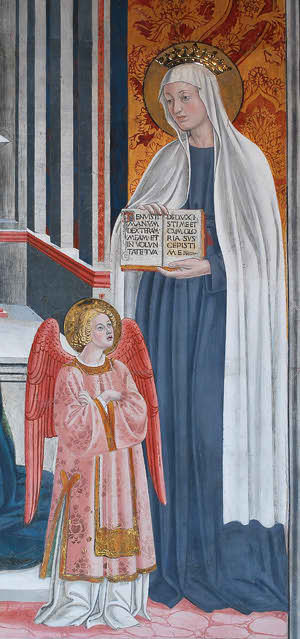
St. Conrad of Piacenza

St. Conrad of Piacenza
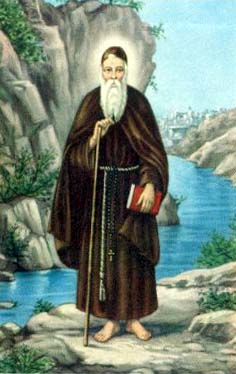
Hermit of the Third Order of St. Francis, date of birth uncertain; died at Noto in Sicily, 19 February, 1351. He belonged to one of the noblest families of Piacenza, and having married when he was quite young, led a virtuous and God-fearing life. On one occasion, when he was engaged in his usual pastime of hunting, he ordered his attendants to fire some brushwood in which game had taken refuge. The prevailing wind caused the flames to spread rapidly, and the surrounding fields and forest were soon in a state of conflagration. A mendicant, who happened to be found near the place where the fire had originated, was accused of being the author. He was imprisoned, tried, and condemned to death.

As the poor man was being led to execution, Conrad, stricken with remorse, made open confession of his guilt; and in order to repair the damage of which he had been the cause, was obliged to sell all his possessions. Thus reduced to poverty, Conrad retired to a lonely hermitage some distance from Piacenza, while his wife entered the Order of Poor Clares. Later he went to Rome, and thence to Sicily, where for thirty years he lived a most austere and penitential life and worked numerous miracles. He is especially invoked for the cure of hernia. In 1515 Leo X permitted the town of Noto to celebrate his feast, which permission was later extended by Urban VIII to the whole Order of St. Francis. Though bearing the title of saint, Conrad was never formally canonized. His feast is kept in the Franciscan Order on 19 February.
STEPHEN M. DONOVAN (Catholic Encyclopedia)

Friday, February 7, 2014


Audio sermon for the feast of the Purification.
Christ is the Light of the world. To truly love is to be self-sacrificing as He is. Once we see God with the eyes of faith we will be tired of this world and be ready to sacrifice all for Him. We will be eager to be dismissed from this world as Simeon was. All the suffering and sacrifice of this world will be considered as nothing once we enjoy the blessing of being with God.

Let us strive to see Christ with the faith and eyes that Simeon had. Just as He was hidden in Human form, yet Simeon saw and believed; so He is hidden in the Holy Eucharist for us to see and believe.

THE ROMAN CATHOLIC CHURCH

Her Doctrine and Morals

Fifth Sunday after the Epiphany

9 February 2014

[Image]

The Sunday

Sermon


Dear Friend,
The evil in this world is permitted by God for two principle reasons. First, God has given us a free will and He honors it even when we use it wrongly. Secondly, God is able in His infinite wisdom and power to make greater good come from the evil He has allowed.
Man has been given a great gift from God in his free will. With our free will we have been placed above all the rest of the physical creation. All the rest of the physical universe is without a free will and acts, through necessity, according to its nature. Love is the giving of our will to another. Consequently only man has the capacity to love. The other lesser creatures may possess affection, but they do not have a free will and therefore cannot truly love. Accordingly, man is the only physical creature that can hate or put his will in opposition to another.
The free will therefore has become a two-edged sword. It is given to man so that he can unite his will freely with God's and thus be capable of love. Man however is also free to refuse this union and love and thus bring sin and evil into the world. Because men are not isolated beings but members of one large family, we see that one man's sin affects not only himself but also the rest of men. The cumulative sins of individual men bring a corresponding evil upon the entire body of mankind. We therefore all suffer the consequences of one another's sins and in this way evil is brought into our lives; even though we may be innocent of a particular sin. God allows this evil because He desires us to have a free will and to be able to love Him, which is a greater good than the permitted evil.
When God allows suffering, pain, or sorrow to enter into our lives, it is because He desires to give us even greater good things. The evil that we have to suffer from time to time is a good thing because it gives us the opportunity to do penance for our sins; and it gives us the opportunity to lovingly take up our cross and follow Jesus. What God takes away from us, He replaces with much greater things (If we will cooperate with Him).
The evils of this world are a constant reminder to us that we are not made for this world. We are only passing through this world. This world is not our home. Without the difficulties of this life, we would soon grow complacent and never seek a better life in heaven. We should therefore, give thanks to God for everything we receive: both the good and the bad. If God gives us riches, or poverty; health or sickness; etc. we must realize that it is all for our ultimate good, and always offer Him praise and thanksgiving. In this way, everything becomes good for us. All things work for the good of those who love God.
Today's Gospel also reminds us to be patient with the evils that He allows to befall us. We must bear patiently the burdens that others impose upon us. Those who today are evil and cause us great pain or suffering, may tomorrow turn out to be one of the greatest of penitents. They also give us the opportunity to grow in grace through the practice of the virtue of patience.
It is possible that an evil man is permitted to live because he is of benefit to someone whom God loves. Evil men in this way provide a good to the rest of society even against their own wills. It is also possible for an evil man have children that will be good. Many times the goodness of one generation greatly outweighs the evil of the other generation. Many of the saints were born to Pagan parents. Some of the great martyrs of the Church were sent to Heaven by their own Pagan parents. The persecutors of the martyrs intended a great evil (the destruction of the Church and faith in Christ), but God drew from this a much greater good and blessing. The martyrs went to eternal happiness in Heaven, and the Church here on earth was given another saint and intercessor in Heaven.
We face the problem of evil in the world every day. The devils want us to focus our attention upon the evil rather than the goodness that God draws from it, or the justness of it as a punishment for sin. We must constantly remind ourselves that there is no evil for those who love God. If we truly love God and unite our wills with His, we will receive eagerly and lovingly whatever divine providence sends our way. The apparent injustices in this life will be perfectly balanced out in eternity. Heaven will be opened up for only those who have used their free will to love God and have avoided using their free will to oppose His will.


ALL THREE OF HIS CHILDREN ARE CANONIZED SAINTS!

February 7 – Saintly King, and Father of Three More Saints

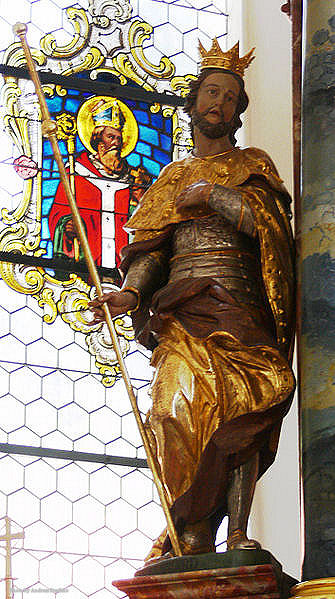
St. Richard, King and Confessor

St. RichardThis saint was an English prince, in the kingdom of the West-Saxons, and was perhaps deprived of his inheritance by some revolution in the state: or he renounced it to be more at liberty to dedicate himself to the pursuit of Christian perfection.
His three children, Winebald, Willibald, and Warburga, are all honored as saints. Taking with him his two sons, he undertook a pilgrimage of penance and devotion, and sailing for Hamblehaven, landed in Neustria on the Western coasts of France.
His daughter, St. Walburga, who became abbess of the monastery founded by her brother St. Willibald. The little vials represent the collected oil that secretes from her bones.
He made a considerable stay at Rouen, and made his devotions in the most holy places that lay in his way through France. Being arrived at Lucca in Italy, in his road to Rome, he there died suddenly, about the year 722, and was buried in St. Fridian’s church there.
His relics are venerated to this day in the same place, and his festival kept at Lucca with singular devotion.St. Richard
St. Richard, when living, obtained by his prayers the recovery of his younger son Willibald, whom he laid at the foot of a great crucifix erected in a public place in England, when the child’s life was despaired of in a grievous sickness: and since his death, many have experienced the miraculous power of his intercession with God, especially where his relics invite the devotion of the faithful.
His festival is kept at Lucca, and his name honored in the Roman Martyrology on the 7th of February.