Pageviews last month

Monday, December 2, 2013

The Last Sunday after Pentecost (The end of our lives and of the world. Those who love God have nothing to fear and eagerly anticipate seeing God.) The Feast of St. Andrew (We are the fish that Christ sent the Apostles out to catch. We will one day find ourselves upon the shores of eternity to be sorted out as the fish that were caught are sorted out. The good will be saved and the bad will be cast into Hell.) The First Sunday of Advent (We are beginning a spiritual journey once again. Let us always keep our goal (destination) in sight, so that we do not forget where we are going.)

Holy Sacrifice of the Mass - Fr. Bernard, OFM 

Fr. Joseph, OFM - First Sunday in Advent 

Saturday, November 30, 2013

THE ROMAN CATHOLIC CHURCH

Her Doctrine and Morals

First Sunday in Advent

1 December 2013

[Image]

The Sunday

Sermon


Dear Friend,
A new year is upon us, and again we are called upon to consider our last end. The world must be in fear and trembling because it is the world. We are called upon to not love this world, but to long for Heaven. The description of the destruction of this world causes all those who love this world to fear and tremble. The lovers of God long for the dissolution of this world and the union with God in eternity.
The world is at enmity with God and God with the world. We are called upon to love God and turn our backs upon the world and all that is of the world. We are to be in the world but not of the world. So as the world fears and trembles at its dissolution, the friends of God are to lift up their eyes knowing that the time of salvation is at hand.
St. Gregory says: " Let them grieve over the ruin of the world who have planted the roots of their hearts deep in the love of it, who neither look for the life to come nor are even aware that it is. But, we who have learned of the joys of our heavenly home must hasten to it as speedily as we may. We should desire to go there with all haste and to arrive by the shortest way. And with what miseries does not the world urge us forward? What sorrow, what misfortune is there, that does not press upon us? What is this mortal life, but a way? And what folly would it be, let you carefully consider, to be weary with the fatigue of the way, and yet not eager to finish the journey!"
The season of Advent is one of penance and mortification. In the spirit of penance and mortification, we naturally spurn the pleasures of the world. The more proficient we become in this the less appealing are worldly pleasures.
We are given many rights by God and most of them enjoin some worldly pleasure. It is in voluntarily renouncing our own rights and pleasures that we are able to draw closer to God. Jesus, as God, has a right to the best that the world has to offer, yet He spurned it all and took up a life of poverty, and humility. He is inviting us in a similar manner to spurn so many things of this world.
The things of this world are not bad. All that God has made is good. We do not spurn the world and its pleasures because they are evil in themselves. It is the use that men make of these things that is evil. When we seek the pleasures of this life in preference to, or in place of the pleasures of God and eternity we sin. God demands that we love Him with a love of preference. The good things of this earth very often supersede our love for God and in this manner we fall into idolatry. We seek things rather than God.
To aid us in overcoming this fault, we are led by our Holy Mother the Church, to enter into the season of Advent and willingly spurn these passing pleasures for a time. In doing this, we imitate Jesus in His poverty and humility, and we discipline ourselves so that we are not overcome and carried away by the pleasures of this world.
Many mortify themselves during Advent because they are being forced to do this by the laws of the Church. This is good, but not the best approach that we can take in preparing for Christmas. Jesus is asking us to willingly do this for the love of Him.
Let us distance ourselves from the world and some of its pleasantries for this time. And remind ourselves that they are all passing away. This world and all its pleasures are only for a time. Either we will leave them or they will leave us. On that day of separation, we need to have assembled some spiritual pleasures for us to enjoy in eternity. If we have only clung to this world and the things of this world we will be greatly afflicted for all of eternity.
If we have not allowed ourselves to become attached to this world and its pleasures we will find it easier to let go of them and reach out for better joys and greater pleasures. The first step is in following St. Paul's admonition to use the things of this world as if we used them not. We do this by denying ourselves the use of them from time to time. Let us make the most of this season of Advent by doing just that. May we begin now to lift up our hearts and eyes to Heaven; in penance letting go of this earth; and longing for the coming of Jesus.

Sunday, November 24, 2013

 
...it is neither wise nor laudable to reduce everything to antiquity by every possible device. Thus, to cite some instances, one would be straying from the straight path were he to wish the altar restored to its primitive tableform; were he to want black excluded as a color for the liturgical vestments; were he to forbid the use of sacred images and statues in Churches; were he to order the crucifix so designed that the divine Redeemer's body shows no trace of His cruel sufferings; and lastly were he to disdain and reject polyphonic music or singing in parts, even where it conforms to regulations issued by the Holy See. 
(Pope Pius XII, Encyclical Mediator Dei, par. 62)


Holy Sacrifice of the Mass - Fr. Bernard, OFM 

Thursday, November 21, 2013


Should we fall into sin, let us at once humble ourselves sorrowfully in His presence, and then, with an act of unbounded confidence, let us throw ourselves into the ocean of His goodness, where every failing will be cancelled and anxiety turned into love.
St. Paul of the Cross

Sunday, November 17, 2013


 Bishop Giles, OFM:
Audio Sermons for: 26th Sunday after Pentecost (Good and evil start small as tiny seeds, but become large over time) Feast of St. Agnes (The Seraphic Spirit) 

Holy Sacrifice of the Mass - Waubeka, WI - Fr. Bernard, OFM 

Friday, November 15, 2013

November 16 – St. Agnes of Assisi

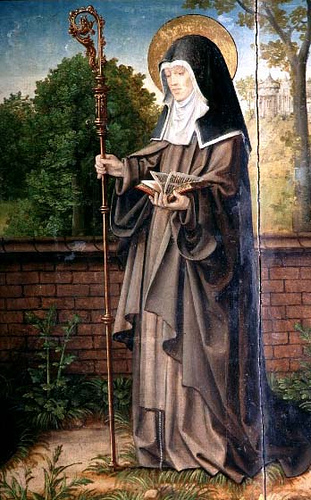
St. Agnes of Assisi
Younger sister of St. Clare and Abbess of the Poor Ladies, born at Assisi, 1197, or 1198; died 1253.
She was the younger daughter of Count Favorino Scifi. Her saintly mother, Blessed Hortulana, belonged to the noble family of the Fiumi, and her cousin Rufino was one of the celebrated “Three Companions” of St. Francis. Agnes’s childhood was passed between her father’s palace in the city and his castle of Sasso Rosso on Mount Subasio.

St. Agnes of Assisi 


On 18 March, 1212, her eldest sister Clare, moved by the preaching and example of St. Francis, had left her father’s home to follow the way of life taught by the Saint. Sixteen days later Agnes repaired to the monastery of St. Angelo in Panso, where the Benedictine nuns had afforded Clare temporary shelter, and resolved to share her sister’s life of poverty and penance. At this step the fury of Count Favorino knew no bounds. He sent his brother Monaldo, with several relatives and some armed followers, to St. Angelo to force Agnes, if persuasion failed, to return home. The conflict which followed is related in detail in the “Chronicles of the Twenty-four Generals.” Monaldo, beside himself with rage, drew his sword to strike the young girl, but his arm dropped, withered and useless, by his side; others dragged Agnes out of the monastery by the hair, striking her, and even kicking her repeatedly. Presently St. Clare came to the rescue, and of a sudden Agnes’s body became so heavy that the soldiers having tried in vain to carry her off, dropped her, half dead, in a field near the monastery. Overcome by a spiritual power against which physical force availed not, Agnes’s relatives were obliged to withdraw and to allow her to remain with St. Clare.  St. Francis, who was overjoyed at Agnes’s heroic resistance to the entreaties and threats of her pursuers, presently cut off her hair and gave her the habit of Poverty. Soon after, he established the two sisters at St. Damian’s, in a small rude dwelling adjoining the humble sanctuary which he had helped to rebuild with his own hands. There several other noble ladies of Assisi joined Clare and Agnes, and thus began the Order of the Poor Ladies of St. Damian’s, or Poor Clares, as these Franciscan nuns afterwards came to be called. From the outset of her religious life, Agnes was distinguished for such an eminent degree of virtue that her companions declared she seemed to have discovered a new road to perfection known only to herself. As abbess, she ruled with loving kindness and knew how to make the practice of virtue bright and attractive to her subjects.
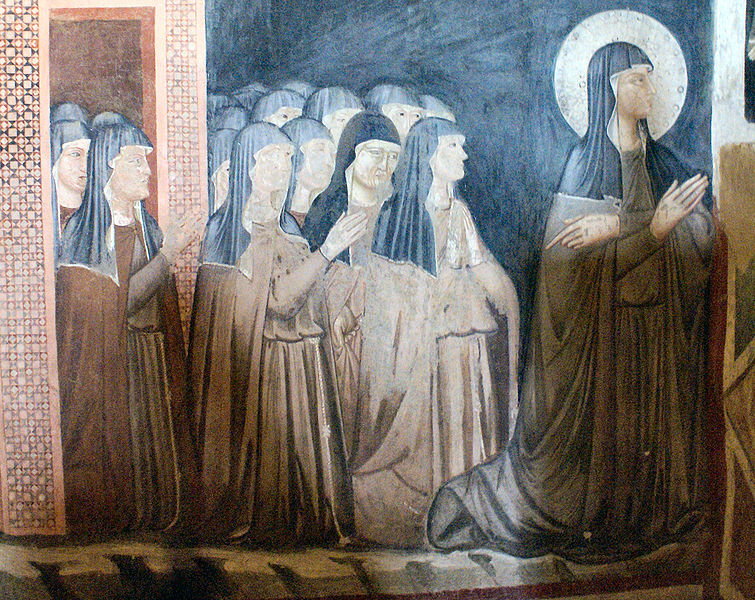
Fresco of Saint Clare and nuns of her Order, Chapel of San Damiano, Assisi

In 1219, Agnes, despite her youth, was chosen by St. Francis to found and govern a community of the Poor Ladies at Monticelli, near Florence, which in course of time became almost as famous as St. Damian’s. A letter written by St. Agnes to Clare after this separation is still extant, touchingly beautiful in its simplicity and affection. Nothing perhaps in Agnes’s character is more striking and attractive than her loving fidelity to Clare’s ideals and her undying loyalty in upholding the latter in her lifelong and arduous struggle for Seraphic Poverty. Full of zeal for the spread of the Order, Agnes established from Monticelli several monasteries of the Poor Ladies in the north of Italy, including those of Mantua, Venice, and Padua, all of which observed the same fidelity to the teaching of St. Francis and St. Clare. In 1253 Agnes was summoned to St. Damian’s during the last illness of St. Clare, and assisted at the latter’s triumphant death and funeral. On 16 November of the same year she followed St. Clare to her eternal reward.

Her mother Hortulana and her younger sister Beatrice, both of whom had followed Clare and Agnes into the Order, had already passed away. The precious remains of St. Agnes repose near the body of her mother and sisters, in the church of St. Clare at Assisi. God, Who had favoured Agnes with many heavenly manifestations during life, glorified her tomb after death by numerous miracles. Benedict XIV permitted the Order of St. Francis to celebrate her feast. It is kept on 16 November, as a double of the second class.
PASCHAL ROBINSON (Catholic Encyclopedia)
Blessed are the clean of heart: for they shall see God.


A man is really clean of heart when he is searching for the things of heaven, never failing to keep God before his eyes.   

   St. Francis of Assisi